





Galactic cosmic rays: Backing the wrong horse
Posted on 24 September 2011 by muoncounter
The popular press is still pushing the preliminary CERN CLOUD results as proof that galactic cosmic rays (GCRs) are a major influence on climate. We've already had an excellent rebuttal here on SkS, featuring Jasper Kirkby's own words urging a more sober interpretation of his preliminary results. Yet those who do not fully understand the science are willing to bet that they have proof positive of the GCR-climate connection. Here is another look at the science of cosmic rays, in which we find out that's not a very good bet.
In horse racing, there's a payout for the 1st, 2nd and 3rd place finishers. All the other horses in the race finish 'out of the money.' One way to go broke very quickly is to repeatedly back the wrong horse.
Let's Check the Odds
The GCR-climate connection is based on well known science: cosmic rays do indeed contribute to ionization of the earth's atmosphere (known as CRII, for cosmic ray induced ionization). Whether CRII leads to enhanced cloud formation is the basic conjecture that GCR supporters want to establish. They must then show that GCR-induced clouds (if any such exist) in turn produce observable climatic effects.
If this is to be a horse a race, we must examine the field of entrants and study their track records. The full family of particles observed when an energetic primary GCR particle enters the atmosphere is illustrated below.
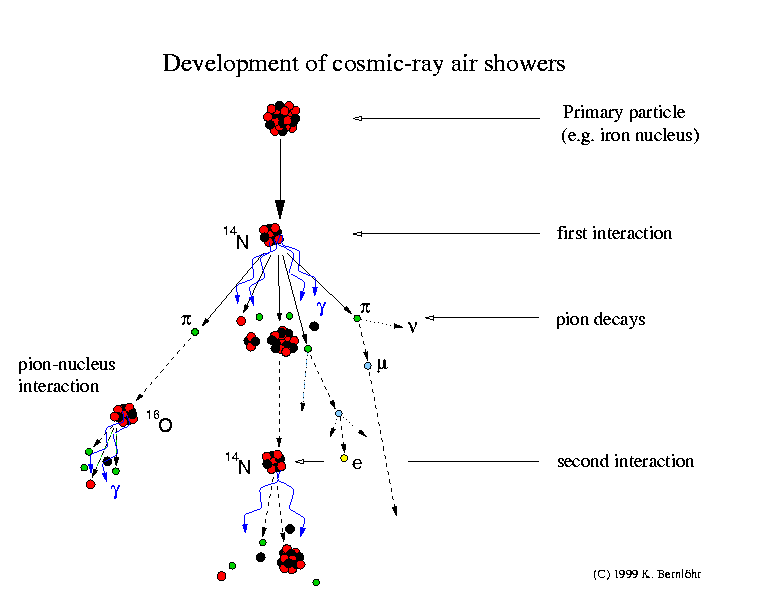
-- source
The CERN CLOUD experiment uses a positive pion beam of 3.5 GeV energy, a relatively middle-of-the-road energy on the spectrum of GCRs. Thus CLOUD backs only one horse in this race: the right-most interaction, pions (π) decay to muons (µ) and neutrinos (ν); note that this interaction does not produce neutrons and is thus invisible to neutron monitors around the world. What of all the other particle interactions on the diagram above? Which horse is the favorite in this race?
Picking a Favorite
Cosmic ray particles sourced by the sun are known as Solar Energetic Particles (SEPs) -- these are typically fast-moving solar wind protons. The energy associated with SEPs runs as high as 5 GeV, equivalent to a flux of 3x10⁻⁶ to 2x10⁻⁵ W/m2. Those on the lower end tend to penetrate only the upper atmosphere; these are the events that can lead to Forbush Decreases (FDs). Even higher energy SEPs can lead to significant increases in particle count rates at the earth's surface known as Ground Level Enhancements (GLEs). These events produce the additional particles shown in the illustration above; we do indeed see these events on neutron monitors.
The image below is a composite of neutron monitor records, illustrating the distinction between the appearance of FDs and GLEs. FDs have been observed as precursors to GLEs. In this example, the count rate multiple is approximately 25%, so the GLE is not particularly energetic.

-- source
Usoskin et al 2009 investigated ionization by GLEs (emphasis added):
"There is a strong correlation between the GLE magnitude (in Neutron Monitor %) and the ionization effect in the stratosphere ... – all strong GLEs led to a more than 10% enhancement of CRII in the polar region. There is still some weak relation in the upper troposphere ... – all strong GLEs lead to a slight positive ionization effect. ...
SEP play a role in the ionization only in the upper-middle polar atmosphere. In all other regions the ionization is suppressed due to the accompanying Forbush decrease. ... There is no ionization effect at mid- or low-latitudes, even for the strongest events. It is clear ... that there is no straightforward relation between the strength of GLE (as measured by neutron monitors) and the ionization effect in polar atmosphere. The net atmospheric ionization effect is defined by an interplay between the SEP event itself and a Forbush decrease, which often accompanies it."
That last statement is key to understanding just how
difficult it is to establish a cosmic ray-climate connection: Not all cosmic ray increases ionize the atmosphere. This horse race went from a walk in the park to a long, slow steeplechase on a very muddy field.
Jumping the Ionization Hurdle
Many GLEs originate as X-class solar flares and are thus relatively rare. The neutron monitor at Oulu, Finland observed 55 GLEs during the 50 year period 1960-2010. The neutron count rate increased by more than 10% in only 21 of these recorded GLEs. One of the largest occurred on 20 Jan 2005, as reported by a number of authors. From Bieber et al 2005,
"Within a 6-minute span on January 20, 2005, the count rate registered by a neutron monitor at the sea level station of McMurdo, Antarctica increased by a factor of 30, while the rate at the high-altitude (2820 m) site of South Pole increased by a factor of 56."
Inuvik and Fort Smith, Canada reported count rate multiples of 4-5; at Oulu the increase was 269%. High multiples of the background count rate persisted for several hours. Per Moraal et al 2008, the protons in this GLE contained a spectrum of energies from ~1.5 - 5 GeV; they also reported that the GLE was composed of at least 3 distinct pulses of particles arriving at the surface of the earth (the first of which caused a Forbush Decrease). Mironova et al 2011 looked at ionization due to this GLE (emphasis added):
"The very high level of neutron monitor count rate increase implies that the ionization of the polar atmosphere was dramatically increased during the event ... the calculated ionization due to the SEP event of 20 January started dominating over the GCR ionization already at 10-km altitude and reached its maximum at about 30 km altitude. In particular, the CRAC:CRII model calculations suggest that the SEP event produced additional ionization in the polar atmosphere in the altitude range 12–23 km, with the number of ions being greater by a factor of 3–30 than the averaged GCR-induced daily ionization in January 2005."
Mironova also looked for atmospheric effects due to this GLE (emphasis added):
"We would like also to emphasize that the observed atmospheric effect for this extreme GLE event was barely significant. No clear atmospheric effect was found beyond statistical fluctuations for the weaker SEP event of 17 January 2005, which is a typical SEP event. This implies that only extremely hard-spectrum (high energy) GLE/SEP events can produce a noticeable direct effect on aerosols in the polar low-middle stratosphere."
Thus one of the strongest known GLEs, producing much more ionization than the typical GCR, had no direct affect on the weather - and the sum of many such events will have no connection to climate.
In this horse race, until the CLOUD experiment can cl
ear the ionization hurdle by investigating the complex relationship between FDs and higher energy GLEs, it will continue to be tripped by this hurdle and always finish out of the money. Those who've put their money on CERN CLOUD finding a GCR-climate connection are backing the wrong horse.
Note: Revised 9/24/2011

Arguments


Your assertion about GCRs and the Younger Dryas is unsupported by the Hughen et al 2004 article from which you take your graph:
The main hypothesis is that the radiocarbon plateaux are driven by oceanic circulation changes (Hughen et al 2000 is ref 13 in the above quote). There is also doubt about the Cariaco radiocarbon spike - Muscheler et al 2008 suggest that upper ocean changes in the Cariaco basin itself influence the record.
"A control knob need not be overwhelming and instant and this GCR link would be offset by oceanic cycles and other weather."
If this so-called control knob is so easily offset, then why maintain that it is a 'control' of any kind? At best, it is a fine tuner. But you cannot suggest that a GCR-cloud mechanism, if real, has some sort of lag. Ionization and cloud condensation either makes clouds or it doesn't.
"A large decrease in GCR flux appears necessary for deglaciation"
Again, where is the evidence for this declarative statement?
The YD is not without its own complexities, as reported by Hughen et al 2000:
the Younger Dryas 14C anomaly, which is by far the largest of the last 15,000 years, is not matched in amplitude by corresponding atmospheric 10Be concentration estimates. Thus, available 10Be data do not support the interpretation of the Younger Dryas 14C anomaly as solely or mostly due to increased production.
In order to promote the speculative GCR-climate connection into a 'control knob,' you'll need a lot more evidence, a mechanism and most critically, an explanation for the climatological non-event at the Laschamp GCR peak.
I was unaware of the complexities of Be10 and I am sure there are some for C14 as well. The correlation of low Be10 measurements with higher rainfall could explain some of the Mercurio chart and is worth looking into further.
Muoncounter and skywatcher, I agree that YD is not strong evidence, but more study is needed to determine the causes which AFAICT remain unknown. Another bit of evidence for a GCR knob is LIA cooling although it coincides with decreased TSI as well. I don't think the Laschamp event is a good test of GCR impact since we were in a glacial state which was probably a somewhat stable state.
If GCR is important to YD, then why is it decoupled between hemispheres? For the corresponding SH events, you have ACR (Antarctic cold reversal) started before YD and finishing as YD gets going.
This is fascinating area of study but the collected evidence from both hemispheres I think supports the idea that these events, associated with deglaciation, have there origin in ice sheet dynamics and interactions with the THC rather than some external forcing.
A geomagnetic reversal includes a period of time (decades? hundreds of years?) when the field is of very low intensity. If the GCR story is to be believed, these must be times of high GCR flux, cloud formation and significant cooling. However, Lee and Kodama 2009:
report high-precision records of a magnetic reversal event at the Paleocene-Eocene thermal maximum (PETM), a cataclysmic global warming event initiated at 55.0 Ma.
But that's the earth's magnetic field; GCR orthodoxy involves solar output - those FDs that are supposed to be harbingers of fewer clouds. Is there a connection between geomagnetic reversals and the solar wind?
Muoncounter no possible connection between magnetic reversals and solar inputs that I can imagine. The PETM magnetic reversal was isolated and probably just coincidence (see the chart in my post 53. Certainly the link from magnetic field reversals to climate is going to be very tenuous due to the rather short duration of the change as you point out.
The failure to explain the Laschamp anomaly is still not a help to your thinking. Why would it have no effect during a glacial phase? And you certainly cannot have any timelag (your #48), given that the few proposed (yet not demonstrated) mechanisms for a GCR-climate connection require it to be immediate.
skywatcher, conditions are different enough during glaciation to have a no GAT response to a large influx of cosmic rays and other coincidental effects. Life which can be killed off by possible coincidental solar flares would be different and restricted; there would be much drier air for less cloud formation; and there would be a lot more dust prior the event for nuclei so the event would not add much.
On infrequent occasions when the Platteville, Colorado,
10-MW radio transmitter matched the F region peak plasma frequency, intence localized sporadic E layers occured at low altitudes (95 km) Here is the link to the full artical
http://www.ngdc.noaa.gov/stp/IONO/Dynasonde/images/HeatPrecip.pdf I started here, got me interested when looking at charged particals (free electrom formation) Ionespheric Heating http://www.ngdc.noaa.gov/stp/IONO/Dynasonde/SpEatHeating.htm
jmorpuss, does your link actually have any relevance to the OP?
Glacial stages cannot be dry - accumulated precipitation (albeit frozen) is a requirement for firn/glacial ice advance. In addition, much of the globe wasn't ice-covered. I don't think your 'we won't see GCR evidence during glacial stages' idea has much support.
Love et al 2011 Are secular correlations between sunspots, geomagnetic activity, and global temperature significant?
We examine the statistical significance of cross-correlations between sunspot number, geomagnetic activity, and global surface temperature for the years 1868–2008, solar cycles 11–23. ... Treated data show an expected statistically-significant correlation between sunspot number and geomagnetic activity, ... , but correlations between global temperature and sunspot number (geomagnetic activity) are not significant. In other words, straightforward analysis does not support widely-cited suggestions that these data record a prominent role for solar-terrestrial interaction in global climate change.
That statistical significance thing is a bother, no?
Skywatcher, yes, my solar flare idea is somewhat spurious, only supported by the increased probability due to lack of a protective magnetic field. But it is not a valid reason as to why the explain the Laschamp anomaly did not produce a climate change, I should not have brought it up. The lack of climate change rests sufficiently on the fact that the glacial climate is dry. How would more clouds form in a dry atmosphere (and stable tropical atmosphere, see Boos paper)?
And yet it must have rained:
Lake Bonneville was a large, ancient lake that existed from about 32 to 14 thousand years ago. ... At its largest, Lake Bonneville was about 325 miles long, 135 miles wide, and had a maximum depth of over 1,000 feet. ... Its relatively fresh water was derived from direct precipitation, rivers, streams, and water from melting glaciers. During the time of Lake Bonneville, the climate was somewhat wetter and colder than now.
-- source
Also worth noting that the Laschamp anomaly (graph in #29) covers both colder and warmer conditions according to delta-18O, so discussions about dustiness of the atmosphere are pretty spurious.
The biggest unresolved question IMO is how the electric field and other cosmic ray effects shown to act on the order of minutes on clouds by Lockwood, Harrison and others could have anything to do with a causal effect over 1000's of years. That is particularly problematic when the effects vary by latitude, there is no worldwide effect. A possible mechanism is the low GCR environment with "fewer low clouds" (very crude I realize) allows more solar ocean heating which warms over longer time periods.
http://en.wikipedia.org/wiki/Van_Allen_radiation_belt
I don't know whether you have looked at this process If not it may help.
Am I to understand that you think the driver for interglacial/glacial is GCR flux instead of the existing milankovich theory? ie we are in a glacial until GCR values drop?
Neither of those have been substantiated as of yet - and there is considerable evidence to the contrary: Dragic's disappointingly scant results, Pierce on aerosol nucleation (at RC) and Love et al's lack of statistical significance.
What is clear about the YD: It's abrupt, and apparently a very unusual event during deglaciation. It is most pronounced around the Atlantic. It's not global, and abundant evidence exists for a 'seesaw' between NH and SH, suggesting changes in global oceanic heat transport via the Atlantic. Whether the trigger is massive flood, other freshwater discharge, ice sheet dynamics, or some other cause, the ocean circulation is altered, and there seems reasonable evidence that this drives the delta C14 changes. It's not a closed book, however, but there is no evidence that GCRs triggered it!
I think that in the Dragic et al paper the diurnal temperature range link is rather diffuse. But your critique of the delay seem unwarranted since the cosmic ray created particles take time to grow (days seems reasonable). As Pierce points how, the higher the initial nucleation rate, the slower the growth rate. So a higher event (7% vs 5%) may be more detectable because there is more lag. Love (above) may be in the worst measurement regime namely decade timescales containing numerous natural cycles.
My main criticism of Dragic's result was the fact that in a 41 year database, they can show only 35 events producing an identifiable change in temperatures. At less than 1 per year, that's not much to hang a hat, let alone a theory, on.
Back on topic, my conjecture about the cosmic ray mechanism is that it shows up in the long term (e.g. upper graphic in #38) so therefore must act through the oceans which are really the only plausible long term actor. I would expect that given a particular rate of overturning, a very subtle warming of SST's would be possible (on average) in a low GCR (lowered cloudiness) regime which over time would warm all ocean layers and aid a flip out of glacial into interglacial. Of course the coincidental increase in TSI is important and may well be the only necessary factor or the main factor. It's not easy to determine.
With C14, you have a calibrated production curve going back 4000+ years thanks to tree ring data but then issues after that. Be10 is also used to date how long rock exposed (Be10 production from cosmic ray hitting O2 in SiO2). As I understand, you are nowhere near being able to infer flux from this because of timescale issues but this doesnt have deposition rate issue so could be used to supplement ice core data in future.
You've given yourself a difficult task. If 'the lack of events causes warming,' you'll need a signal to trace. Unfortunately for that, low GCR flux rates correspond to the highs of the solar cycle (see the graphs here, specifically figs 1 and 4 for the years 2000-2004 - peak of cycle 23).
So if solar activity peaks -> TSI in any way, wouldn't any GCR-induced warming be swamped by the coincident uptick in solar forcing? If so, you'll have a hard time pinning any warming directly to the lack of GCRs.
I always find it difficult to prove anything by demonstrating a lack of evidence, but I know others in the community who don't hesitate to do so. There certainly isn't any basis for saying that you shouldn't give it a try.
I notice mercurio 2002 has single cite and no followup by mercurio either. Guess we are not the only ones unconvinced.
Scaddenp, There is evidence for the weather link (in 35 cases in 41 years as muoncounter pointed out), but not evidence for a climate link other than the top graph in #39 and similar which all coincide with and can be explained by TSI.
On your conjecture - you appear to be using a high;y-criticised graph from #38 which has lags/errors of tens of millions of years in order to support a conjecture about oceanic circulation and glacial cycles. Do you think it's plausible for the oceans to work on a timescale as slow as millions of years? Even a few tens of thousands of years is stretching credulity a bit. Nonetheless, a graph covering 500 million years can't hope to support your argument for the glacial-interglacial cycle. So again, what's the mechanism?
"we found no widespread detectable changes in cloud cover at any tropospheric level within a 20 day period of the solar forcing clearly associated with solar activity changes."
For solar activity they mean TSI, F10.7 flux and GCR.
Do the authors understand that TSI decreases coincide with GCR increases (not reductions)?
Dr. Laken obviously knows his field and I should not imply otherwise.
I'm not sure what the purpose of that Mecurio "cite" is. The author is presenting a simple overview of modern climate in that section, and basically says "there's this thing called PDO" and "these people all proposed different mechanisms for its cause" (one of them being Mecurio).
As such, it makes no actual use of content of the paper, and puts no weight whatsoever on the conclusion. I suspect that if I'd written an e-mail to the author saying that Eurasian Leprechaun Farts cause the PDO, he might have cited my e-mail as well. He was just looking for a list of different proposed causes to demonstrate that no one actually knows.
It's a "throwaway" cite with no bearing on climate change and giving no veracity to an un-peer reviewed, un-published and otherwise ignored paper.
You can't discuss that Mecurio paper and claim to be discussing science. It's like discussing any number of self-published crackpot theories out there. They aren't worth anyone's time.
Stick to meaningful and robust (or at least published!) papers. Don't assume that because a paper has a published format and some letters after the author's name that that means it's (a) good science and (b) true.
you really badly quoted from Ben Laken site, hope it's unintentional.
Dr. Laken whas reviewing the litterature and found that FD events "not necessarily isolate the effects of GCR variations effectively". Their new paper address exactly this and found that "However, the analysis presented in this work shows that following careful isolation of TSI and GCR variations, neither is found to be significantly associated with changes in cloud cover."
Hopefully next time you'll carefully read before questioning the understanding (no less!) of reputable scientists.





