





It's ozone
The skeptic argument...
It's ozone
The Ozone Layer stops UV radiation from entering our atmosphere. As the ozone layer has been declining in recent decades, that may be causing global warming.
What the science says...
Multiple satellite measurements and ground-based observations have determined the ozone layer has stopped declining since 1995 (Yang 2005) while temperature trends continue upwards.
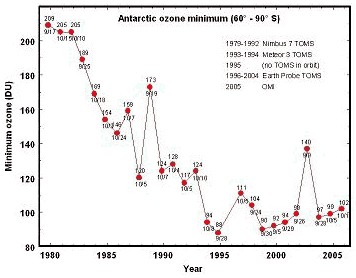
Figure 1: Antarctic ozone minimum (Atmoz).
Last updated on 26 June 2010 by John Cook.

Arguments


Ozone is thought to be a strong greenhouse gas. But thats far less relevant then its blocking potential for UV since that affects joules punched directly into the oceans.
So if industrial chemicals were destroying ozone there is the very real potential for less ozone to account for part of the alleged 1978-2000 divergence between solar irradiation trends and global temperatures.
Ozone is split by UV and the O atom combines with H to form hydroxyl radical OH. Methane reacts with the hydroxyl radical producing a methyl radical which bonds with another hydroxyl radical to produce formaldehyde.
Formaldehyde reacts with hydroxyl radicals forming carbon dioxide and water vapor.
You could summarise the reactions into:
(3)CH4 + (4)O3 = (3)CO2 + (6)H2O
Oxidation of methane is the main source of water vapor in the upper stratosphere
All arguments for “It's the ozone…” are on: http://omsriram.com/GlobalWarming.htm. About UV radiation on the Earth surface, decide a ozone concentration with lover stratosphere, so temperature in this layer (http://www.atmosphere.mpg.de/media/archive/1385.jpg - it’s same different than above-mentioned Figure).
Did you notice the upward trend since 1998? We or on the road back up the hill - but true - it is going slowly.Unfortunately the damage done by the CFC's must not be underestimated. But we are going up. I am confident that this will result in more of the sun's radiation being blocked. The CO2 going up will also help!~
Re#3: For rising temperatures see e.g. here.
[DB] Actually, the chart does nothing to explain Arctic ozone holes, as the chart above deals with the Antarctic. :)
The Arctic ozone hole that formed this winter (2010/2011) was primarily due to prolonged cold in the stratosphere during the long Arctic winter:
"at some altitudes, the cold period in the Arctic lasted more than 30 days longer in 2011 than in any previously studied Arctic winter, leading to the unprecedented ozone loss"
This NOAA page does an excellent job differentiating between the Antarctic and Arctic ozone depletions.
Note that stratospheric cooling is an expected effect of AGW...
Or, maybe it's due to the cold, period(?).
The ozone hole is a result of both the cold and CFCs.
The abnormally cold stratosphere allows the formation of clouds, which serves as a catalyst for the destruction of ozone. The reaction also requires chlorine, which is supplied by CFCs.
Thank you.
The reason for the colder stratosphere is a somewhat grey area ...
A cooling stratosphere is entirely expected given current forcings.
http://scienceofdoom.com/2010/04/18/stratospheric-cooling/
The reason for the colder stratosphere is a somewhat grey area ...
The abnormally cold arctic stratosphere this spring is attributed to a lack of polar vortex disruption (which is turn is a result of weak planetary waves). The strong vortex keeps the arctic stratospheric air isolated, allowing it to cool sufficiently to form clouds.
As the stratosphere continues to cool due to an increase in green house gas, it'll be interesting to see if this occurs more frequently.





