





Prudent Risk
Posted on 26 February 2011 by dana1981

In their recent letter to US Congress, a group of "skeptic" scientists argued that based on what they deemed the "modest warming" so far, and that the consequences of that warming have thus far been manageable, the "prudent path" forward involves continuing with business-as-usual. However, as the first Prudent Path Week post noted, we're primarily concerned about the warming and climate change that are yet to come.
Determining the prudent path forward requires not just looking at the changes which have occurred so far, but also assessing the risks to come and weighing the costs vs. benefits of addressing them. That's what we will attempt to do in this article.
Probability of Future Warming
The "skeptic" letter to Congress focuses on the 0.8°C warming of surface air temperatures we've seen so far. However, there still remains unrealized warming "in the pipeline" based on the greenhouse gases we've already emitted. How much unrealized warming depends on the climate sensitivity to the energy imbalance caused by the increase in greenhouse gases. Roe and Baker (2007) examined the probability distribution of climate sensitivity values:
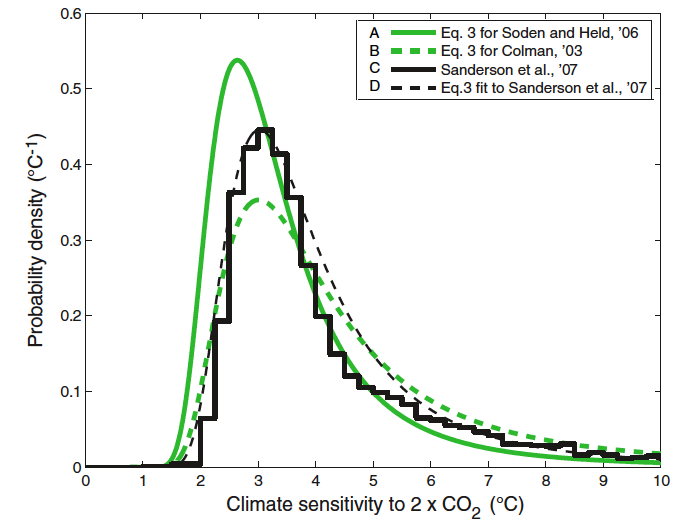
Figure 1: Climate sensitivity distributions from Roe and Baker (2007)
However, Annan and Hargreaves (2009) concluded that there is a 95% probability that climate sensitivity to a doubling of atmospheric carbon dioxide (CO2) is very unlikely to be more than 4.5°C. Note that this excludes slower-acting feedbacks such as melting ice, which Hansen et al. (2008) concluded increases the long-term climate sensitivity to approximately 6°C for CO2 doubling. However, for our purposes we will consider the short-term 4.5°C sensitivity a plausible worst case scenario.
This high climate sensitivity value poses a very large potential risk. In the business-as-usual scenario promoted by the "skeptics", the atmospheric CO2 concentration would be around 850 parts per million in 2100. This represents more than a doubling of atmospheric CO2 over the next 90 years.
Hot Math
The math is not in our favor. The planet has already warmed 0.8°C with another 0.6°C to come from current CO2 levels. Even in a best case scenario, if we continue with business as usual, the planet will warm a further 2°C over the next 90 years. This puts us well beyond the global warming 'danger limit' even in the best case scenario pushed by the "skeptics". In the worst case scenario, we could be looking at 7°C global warming from pre-industrial levels by 2100.
Ramanathan and Feng (2008) applied the Roe and Baker climate sensitivity distribution to some important predicted climate tipping points, as shown in Figure 2:
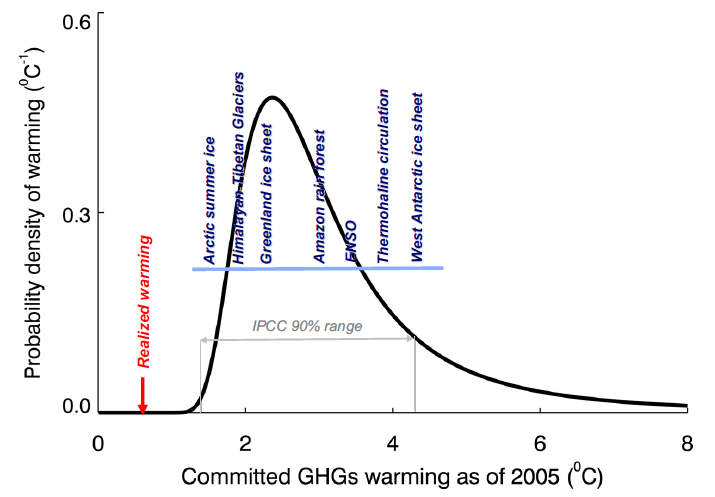
Figure 2: Probability distribution for the committed warming by GHGs between 1750 and 2005 from Ramanathan and Feng (2008). The normalized distribution is calculated from the probability density function given by Roe and Baker (2007), and the mean and standard deviation of the uncertainties associated with feedback processes are fitted for Sanderson et al. (2007). Shown are the climate-tipping elements and the temperature threshold range that initiates the tipping.
This distribution is based on the warming that we're committed to just based on the greenhouse gases we've emitted thus far. Ramanathan and Fang note that aerosols are likely offsetting a significant amount of global warming, and have a very short lifetime in the atmosphere. So as countries continue to clean their air, aerosols in the atmosphere will quickly decrease, leading to further warming. Ramanathan and Fang estimate that we are most likely already committed to 1.6°C additional warming, which appears sufficient to trigger the eventual collapse of the Greenland Ice Sheet, the Himalayan Tibetan glaciers, and summer Arctic sea ice, among other consequences.
Unconvincing Skeptics
As Bart discussed in the second Prudent Path Week post, aerosols represent a significant uncertainty - one which the "skeptics" try to have both ways, arguing that it's both significantly higher and lower than the IPCC estimates. This aerosol uncertainty is one of the biggest contributors to the large range of possible climate sensitivity values. But even in a best case scenario we are already committed to a dangerous amount of warming. And in a risk assessment, one must also consider the likely and worst case scenarios. In our case, they are not pretty.
As we saw in the third Prudent Path Week post, the "skeptics" have given us little reason to believe that the unlikely low climate sensitivity values are a reality. In fact, on climate sensitivity and aerosols, in their letter to Congress the "skeptics" contradicted themselves by a factor of ten. As Andy showed in the fourth Prudent Path Week post, the carbon cycle feedbacks may cause atmospheric CO2 to rise even faster than the IPCC expects. And as Robert showed in the fifth Prudent Path Week post, we're already seeing significant consequences from the "modest" warming thus far, as the polar regions are both warming and losing ice extensively.
Not only do the "skeptics" want us to ignore the plausible worst case scenarios, but they want us to ignore the most likely scenario. They want us to continue behaving as if there's nothing to worry about. Is this really prudent? That partially depends on the costs of averting climate change.
Costs vs. Benefits
In case you're still not convinced about the prudent path forward, it's worth evaluating every possible scenario. Even if the "skeptics" are right and the better-than-best-case scenario is reality, the costs of reducing carbon emissions are quite small. Moreover, there are additional ancillary benefits to doing so, such as addressing ocean acidification and peak oil. If the "skeptics" are wrong, the benefits of reducing carbon emissions will outweigh the costs several times over. If they're wrong and we fail to act, the most likely scenario is disastrous, and the worst case scenario is catastrophic.
The risks are very asymmetrical. Not only is it more likely that if our estimates of climate sensitivity are wrong, the sensitivity is higher than we think, but the consequences of no action are far worse than the consequences of taking action. The two worst scenarios are:
- if the "skeptics" are right and we limit carbon emissions - in which case the costs will be minimal and we'll still reap the benefits of addressing peak oil, ocean acidification, and other pollutant emissions.
- If the "skeptics" are wrong and we take no action - in which case we will likely experience catastrophic climate change this century.
What's Prudent?
Consider the following analogy: you're driving your car, and you start to feel that the brakes aren't working quite properly. Most people would agree that the prudent path involves spending a modest amount of money to take the car to a mechanic, because if the brakes go out, it presents a potentially catastrophic scenario. This sort of preventative action is good risk management.
In this case we're dealing with the global climate, on which every living thing on the planet relies, and we're facing a disaster in the most likely scenario if we continue on the business-as-usual path which the "skeptics" tell us is "prudent". The "skeptics" would have us continue driving the car in the blind hope that the brakes will never give out. After all, we haven't gotten into a wreck so far, so continuing to drive with faulty brakes must be safe!
To sum up:
- If we continue in a business-as-usual scenario, the results range from bad to catastrophic.
- The cost of reducing carbon emissions and changing paths is minimal.
- The benefits of reducing carbon emissions outweigh the costs several times over.
- In trying to make their case to continue on the business-as-usual path, the "skeptics" contradicted themselves on major issues. By a factor of ten. Twice.

Arguments


I always like your posts.
In paragraph 4 I think you mean "unlikely to be more than" (not less than). I would be interested in expanding the reference to the minimal costs of reducing carbon emmissions.
Moderator: this post can be deleted.
michael #1 - I provided a link to an article I previously wrote on the costs of carbon pricing. Click the link for more details.
I'm really concerned that the huge aerosol loading from Asia is providing quite a substantial buffer, that may be giving some a false sense of security.
Image from here.
Interestingly, I remember almost the same thing when I was a little boy growing up in East Tennessee. Everyone used coal furnaces and in the winter everything was covered in suit and you could not see 1/2 a mile ahead.
China is closing down old dirty coal fired power plants at a fairly rapid pace. I'm also concerned at what this is going to unleash in terms of extra warming. If mid-century cooling was aerosols, is the same thing going on now?
If the covering letter were to be signed by as many heavy-weight scientists as we can muster, it would obviously raise its profile. I think that we could get more out of this exercise if we offered the opportunity for them to raise any queries they have regarding the science contained in the post. If we explained that because there could be other members of Congress that might have similar points of concern, all queries will be in open forum, i.e. open to view by all, at .... (‘Congress Queries’? – only posts by members of Congress with replies by selected scientists.)
These people are politicians, so they will be acutely aware that the media may well quote from this page in order to demonstrate an individual’s level of concern on the subject of Climate Change, a subject that will obviously be somewhere near the top of the agenda in the next round of elections to Congress. They would be foolish to appear uninterested, so will probably want to raise a question or two, if only for appearances. However, in raising any questions, they will have to make sure they understand them in case they get called to explain their concerns. Who knows, they might even come to see that ‘business as usual’ is not a realistic option! If we could raise enough interest now, it might even be a good media story before we get any replies. That would make the public turn to the ‘Skeptical Science’ website in order to check up on their member of Congress.
Pity this ‘Prudent Path’ group didn’t write to all senior politicians everywhere – we could really spread the word then!
If on the otherhand a negative effect or threat is very obvious, it is more than likely only a local problem, whereas on a global scale, someone or some species is coming out ahead in some way. And since it is impossible to predict all outcomes (in a global sense) until this is possible, "business as usual" is about all you can justify.
"a negative effect or threat is very obvious, it is more than likely only a local problem, whereas on a global scale, someone or some species is coming out ahead in some way."
I suppose you can go on wearing those rose-tinted glasses for a long while. Since all threats are local, let's go on with our "What! Me worry?" business as usual.
Let's take just one local threat: Sea level rise threatens to inundate sections of coastal Louisiana with increasing frequency. No big deal, you say, who cares about a bunch of marsh grass and pelicans? That's a local threat that won't bother anyone, say up Yooper's way, basking in the warm waters of Lake Superior.
Heard of Port Fourchon, at an elevation of 0.64 m (2.1 ft)? Sea level there is rising at more than 9mm/yr (a combination of sea level rise and land subsidence). From a 2008 report prepared for the South Louisiana Economic Council:
This port services about 90 percent of all deepwater rigs and platforms in the Gulf of Mexico and it is also the host for the Louisiana Offshore Oil Port (LOOP). We estimate that in 2006 about $63.4 billion worth of oil and natural gas was tied to this port via the LOOP and the offshore platforms the port helps to service.
We conservatively estimate that a three-week loss in services from Port Fourchon would lead to:
• A loss of $9,994.7 million in sales at U.S. firms;
• A loss of $2,890.9 million in household earnings in the U.S., and;
• A loss of 77,440 jobs in the nation
And that was in 2008! Put storm surge on top of sea level rise and the LOOP goes out of service (and with it, 13% of US oil imports). Do that when oil is already pushing $100/bbl and you've got economic meltdown. No, it's not local; this particular threat will come find you.
It's Not Bad (argument #11)
Insisting that negative effects can only be local while positive effects are global is an impressive display of sophistry and willful ignorance since you are a long-time commenter on this site.
It is actually worse than that, the climate system has no brakes (once the planet has warmed, the change is IRREVERSIBLE).
All the best we can do is leave the accelerator, hoping that the speed already reached isn't enough to crush ourselves in the giant concrete wall ahead. But this "skeptics" want us to continue to accelerate towards the concrete wall, saying that:
"there is not evidence that hitting a concrete wall is dangerous"
and claiming that all the physisists, engineers, doctors, firemen and all the people that shout:
"stop!"
are dishonest people with a hidden agenda, an agenda that includes a range astonishingly large of possibilities, from financial speculation (with carbon credits) to communism (the "logic" is like: since capitalism depends on fossil fuels, and communism is against capitalism, then being against fossil fuels is being a communist)
The nonsense of the "skeptics" is so big, that it reminds me the words of Albert Einstein:
"There are two infinite things, the Universe and Human Stupidity, and I am not sure of the former"
Can you provide evidence that ocean acidification is a local effect only? Perhaps you meant that since I have a fresh water pond in my back yard that when the ocean ecosystems are damaged 30 miles away I will not be affected?
which is an even more illogical claim when you consider that Capitalist societies did *more* to move to renewable energy over the 1970's, 1980's & 1990's than any of the Communist countries did. The reason Russia's environment is now so up the creek is because of their rampant over-use of fossil fuels during the Communist Era. Still, such logic will be lost on the Deniers.
"Can you provide evidence that ocean acidification is a local effect only?"
I was referring only to temperature, but will admit I didnt specify this. At any rate, I dont think the idea is limited to temperature, and as far as ocean acidification, the theory of punctuated evolution depends on environmental stress.
"the theory of punctuated evolution depends on environmental stress."
So we are doing calcite bearing creatures a favor by setting in motion the chemistry that dissolves their shells?
Comments like this reveal a fundamental misunderstanding of the time scales involved. Environmental changes, even in punctuated equilibrium models, take generations. In the context of the rapid change, associated with punctuated equilibria, the word rapidly is understood to be " ... by geologist's standards". So with a coarse and incomplete fossil record, "a speciation that took 50,000 years would seem instantaneous".
Anthropogenic changes to the environment are not on a 'punctuated' time scale. The more appropriate word starts with a C.
"So we are doing calcite bearing creatures a favor by setting in motion the chemistry that dissolves their shells?"
According to Darwin, those within the species with the right genes to adapt would survive. By the same token, its the creationist that should be more concerned, and yet, its the liberal scientist that seems to have very little faith in nature's plasticity, and the argument is that it requires "millions and millions" of years. And would these genes not already be there since the CO2 levels were higher at some point? Or, why do insecticides and antibotics loose their potency? Apparently every flu season, there is a need to innoculate people given that viruses are mutating continuously.
The reason insecticides and antibiotics loose effectivenes comparatively quickly is becuase the time between generations is measured in days (which is why drosophola melanogaster is used for experiments in genetics) for insects and seconds/minutes for bacteria.
"If on the otherhand a positive effect is very obvious, it is more than likely only a local benefit, whereas on a global scale, someone or some species is suffering in some way. And since it is impossible to predict all outcomes (in a global sense) until this is possible, "being cautious" is about all you can justify."
For any not familiar with the topic of Peak Oil (and even those that are), I can recommend 'Oil, Smoke and Mirrors' on YouTube (make sure you watch the interviews that follow the film), and 'The Crash Course' at ChrisMartenson.com (it is much better to watch all 20 sections rather than just the short introduction) - o.k., I know I should get a life!
"the only reason viruses, bacteria & insects develop such rapid resistance is because of their extremely short life-cycles-which allows for the rapid accumulation of genetic mutations"
So you are saying then that a short life span favors survival of the species. If so, animal kingdom life span is a proxy for environmental stability, and the fact that we dont live forever (and have "evolved") means the Earths environment has always been changing. I thought evolution was a good thing? Please clarify.
We don't need to use evolution as a measure of environmental change, there is plenty of direct evidence that the environment changes. We all know that, and it is entirely uncontraversial.
BTW, if we lived forever, there would be no evolutionary adaption to viral and microbial pathogens (which don't live forever). So even if the environment were unchanging, we would not survive as a species if we lived forever, so your argument isn't even logically consistent.
"we would not survive as a species if we lived forever, so your argument isn't even logically consistent. "
If a species were able to live forever, I think it could also assume it is surviving quite well.
The probability of bad at current emissions levels is so low that may be it should be left out of this statement.
Do you have any information to substantiate this claim? Perhaps something from a peer-reviewed science journal?
Given that some 'results' are already starting to happen, your optimism is curious.
I read Paul's comment as 'there is no way it will be only "bad", if things continue unabated'.
The trees & wildlife killed off in the Amazon droughts of 2005 & 2010 (both of which were considered very unlikely events), the farmers & ranchers affected by the floods in Pakistan and the drought in Texas, and the Russians affected by the extraordinary heat wave in Moscow would beg to differ with your claim:
That does not represent an optimistic point of view. Indeed, it is too pessimistic. A climate sensitivity of 2, for example, would be bad with BAU, but it is far from clear that it would be catastrophic, and has not been ruled out by the science as yet. Rather than being too optimistic, Magnus is too pessimistic.
Unfortunately, catastrophic is more probable than merely bad with BAU. But in the event that the world's governments continue to fail future generations, there remains some hope that the worst possible consequences will be avoided.





