





A Merchant of Doubt attacks Merchants of Doubt
Posted on 20 December 2010 by John Cook
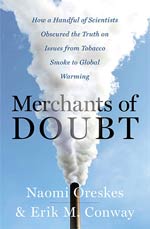
Two things are required to put the climate 'debate' in context - an awareness of the many lines of evidence that global warming is happening & that humans are the cause - and an understanding of the techniques used by climate skeptics to sow doubt and obscure the full body of evidence (quick plug, both these themes are fleshed out in the free booklet, The Scientific Guide to Global Warming Skepticism). A must-read historical perspective is provided in Merchants of Doubt by Naomi Oreskes and Erik Conway, which shows that the same people who sowed doubt about climate science also used the same techniques (and even the same arguments) to sow doubt about the effects of smoking, ozone depletion and other impacts of industrial activity on the environment. Predictably, one of the Merchants of Doubt, Fred Singer, has come out attacking the book. Unsurprisingly, he has used the same obfuscating techniques in his attack. It's like watching the sequel to the book unfold in real time.
What Singer attempts is a classic strawman argument, attacking an argument that the book never actually made. Singer argues:
Oreskes' and Conway's science is as poor as their historical expertise. To cite just one example, their book blames lung cancer from cigarette smoking on the radioactive oxygen-15 isotope. They cannot explain, of course, how O-15 gets into cigarettes, or how it is created. They seem to be unaware that its half-life is only 122 seconds. In other words, they have no clue about the science, and apparently, they assume that the burning of tobacco creates isotopes -- a remarkable discovery worthy of alchemists.
All one has to do is read the relevant section of Merchants of Doubt to find Singer has completely misrepresented the words of the book:
Seitz saw irrationality everywhere, from the attack on tobacco to the "attempt to lay much of the blame for cancer upon industrialization." After all, the natural environment was hardly carcinogen-free [Seitz] noted, and even "the oxygen in the air we breathe ... plays a role in radiation-induced cancer". (Oxygen, like most elements, has a radioactive version -- oxygen 15 -- although it is not naturally occurring.)
Ironically, the sentiments on oxygen isotopes actually come from Frederick Seitz, one of the original Merchants of Doubt. In no way does the book suggest the burning of tobacco creates oxygen-15 isotopes. Fred Singer's attempt to discredit Merchants of Doubt only further reinforces the rhetorical techniques illuminated in the book. Singer attacks Oreskes' and Conways' understanding of the science by completely misrepresenting their understanding of the science.
H/T to Tim Lambert at Deltoid.

Arguments


Analyzing the skeptical arguments is as important as analyzing the denial and doubt-mongering strategies and backgrounds.
Jan Paul van Soest
Or did I miss that part?
Bob
It seems to me that originally Seitz did not mean that oxygen causes cancer by its own radioactivity, but that oxygen enhances the effects initially caused by radioactivity. If this is true, Oreskes and Conway mistook Seitz's intention, and Singer took it right. We should not blame Oreskes and Conway, however, since the wording of Seitz was obscure. We cannot blame Seitz with this particular fault, however, since his document was an internal one and also oxygen was not its main issue. So, while this may be another instance of failure of scientific communication, it can hardly play a role of a piece of evidence of malpractice of anyone.
As John said, it's the same techniques debunked by the book. Classic FUD (Fear, Uncertainty, Doubt) techniques.
Oreskes was definitely a working scientist. I remember a particularly interesting review of numerical models in geology that was published in Science in the 90's. I was surprised when I saw her being referred to as a historian a decade later.
I think Kooti is probably right about Seitz's original intentions and O&Cs mistaken take on it - though we don't really have context so it's really hard to tell. But Bern is also right that Singer is dead wrong and likely insincere in his interpretation.
S funding of research related to AGW is a "slippery subject" ... :
“Even the big oil companies have long since been putting their real money into projects dedicated to showing how they are in favour of a "low carbon economy". In 2002 Exxon gave $100 million to Stanford University to fund research into energy sources needed to fight global warming. BP, which famously rebranded itself in 2004 as "Beyond Petroleum", gave $500 million to fund similar research.[...]”
I have some ideas about that.
Not having read either book I could be wrong about both, I have to go by what facts the OP has included and assume that he is taking both comments in context.
And of course the first comment on the article by rockytom has to be an ad hominem argument against Singer. Whether it is true or not, it is still an ad hominem argument.
are you a lawyer? That's my impression judging from your comment.
The fact is that Singer, in the one example cited, was wrong. That's it. We'll wait for the many others he possibly found.
"There is much talk these days about the effects of the environment in causing cancer. This is often coupled with an attempt to lay much of the blame for cancer upon industrialization. While there's no doubt that certain industrial occupations carry special hazards, it seems quite fair to say that under the best circumstances the natural environment is not carcinogen free. Among other things we know that the oxygen in the air we breathe and which is essential for life plays a role in radiation-induced cancer".
and they add "(Oxygen, like most elements, has a radioactive version -- oxygen 15 -- although it is not naturally occurring.)" and refer to note 99 Michel Ter-Pogossian et al, "Radioactive Oxygen 15 in Studies of Kinetics of Oxygen of Respiration," American Journal of Physiology 201 (1961)
So Oreskes and Conway know well what they are saying. Seitz is making a blurry statement which contains an induced inference about oxygen being related with radiation-induced cancer ('plays a role' is the blurry statement that happily produces the expected inference), so the authors only can cite a proper text saying that Oxygen 15 in not naturally available and let the reader to infer Seitz' intentions. That is, nothing to blame on O. and C.
It's a pity that Dr. Singer hasn't followed the same protocol and quoted "Merchants of Doubts" properly.
I only can add two things:
1) Intentionally blurry pseudo-assertions are common in any debatable topic. Singer, Seitz and a few people hanging comments here are good evidence of that. We can't let them misguide us nor we can answer their tricky ways with impatience and using their methods.
2) Let Singer do all the hating. Criticizing Singer morals and abilities is following his steps.
Singer has a history of twisting science to serve powerful corporate interests. He's a shill, pure and simple. You wouldn't take the time to defend him if you didn't share his politically-motivated opposition to AGW theory.
Observations indicate global warming less than the low end scenario, yet the public discourse is:
'yeah, yeah, but it could be really bad.'
The longer the observations converge to a mild rate of change, the more we must question the IPCC range of doubt.
It was my understanding that we're tracking right along the mid-level IPCC projections, matching the modeled response to what we are actually emitting, although with much higher ice melt rates than projected (as the IPCC did not include melt feedbacks in their estimates).
I do not think your claim is correct.
Actually, they don't. They're right in line with a 2-4.5C. Except now we have another problem: oceans are soaking up more heat that we originally thought, and they are acidifying. That's a double whammy on marine life, with potentially devastating results on many aquatic ecosystems.
But yeah, let's continue raising CO2 concentrations to levels not seen for millions of years. That sounds like a swell idea...
Any more doubt to sell?
Really? I hadn't heard. What observations are you referring to?
Subsequent comments should go to It's not bad or IPCC is alarmist or It's not happening.
No, #17 was just an run-of-the-mill innuendo, with a basic formulation. Thanks for that link, very interesting!
The problem with extreme contrarians, pathological sceptics or whatever (not using the D word in this post!) is that they no longer seem to possess the ability to realise when they are wrong.
http://www.clivehamilton.net.au/cms/media/why_we_resist_the_truth_about_climate_change.pdf
Regarding #17, please do a least squares fit of the MSU data (UAH and RSS), the surface temperature indices (NOAA, GISS, or CRU) and the SSTs (Hadley).
Do this fit since 1979 ( the beginning of the MSU data ).
Then refer to the IPCC which predicts the best estimate for a low end scenario.
Note that all the above measurements indicate trends less than even the low end scenario.
Note this message quickly, because the mods don't seem to like reasoned responses which contradict popular conception.
I would suggest moving ongoing discussion of this argument over to that thread, as it's right on topic there.
I've seen much the same thing with Basic/Intermediate/Advanced discussions and duplicate postings of updates to one of those three - we end up with duplicate topics that don't share comments.
I would suggest URL redirects rather than the duplicate content.
So I consider the blogs a snapshot in time - often blog posts are actually rebuttals being added into the rebuttal section. Then over time, subsequent blog posts feature updates to the rebuttals (a good example is Greenland ice loss which is constantly updated as observations find the ice sheet is losing ice at a faster rate as time goes on). So yes, there is some duplication of content as the rebuttals mirror the blog posts. An additional complication is having 3 levels of rebuttals - we debated at length what to do about comments. Do you have 3 different sets of comments or one set of comments for all 3 rebuttals. I opted for the simplest option (and not just because it was the least amount of work) of having a single set of comments. If you can think of a better way to do it, I'm all ears. :-)
I would challenge you to do this analysis for yourself.
The data is publicly available and the objective trend is unambiguous.
You might also look at this article on Deep Climate (June 2009), indicating that recent trends are slightly below predictions, but well within significance limits. I expect that if this analysis were to be updated with the very warm 2010 data there would be even less difference.
Short term variation in global temperatures is quite large compared to the ongoing trends - you really need to take a 25-30 year view to really see what's going on.
Your suggestion that "observations converge to a mild rate of change" really isn't supportable.
It certainly is. Now you're watching!
As an addendum (yes, I know, additional requirements - never fun, always late in the project, very Dilbertian) it would be great to add to the HTML for the Basic/Intermediate/Advanced with the link tabs for them indicating how many comments are on each version, thus indicating where the real conversations are taking place.
That might be appropriate if each level rebuttal had its own comments thread but currently there is one comments thread for all 3 levels. That decision isn't locked in stone, I *may* split it into 3 levels down the track.
UCSD (University of California at San Diego) Professor of History and Science Studies "Naomi Oreskes" presented this 58 minute lecture on the History of Global Warming Science.
http://www.youtube.com/watch?v=2T4UF_Rmlio
Many viewers will be surprised to learn that the science as been settled (more or less) for five decades.





