



 Arguments









Low solar levels during Ordovician Period
What the science says...
During the Ordovician, solar output was 4% lower than current levels, and there was a large continent over the South Pole. Consequently, CO2 levels at around 1,000 to 2,300 ppm were actually low enough to promote glaciation in the southern continent of Gondwana. Ample geological and geochemical evidence points to strong weathering in parallel with the cooling of the Ordovician climate. Since rock weathering reduces atmospheric CO2, this again reinforces the scientific fact that CO2 is a strong driver of climate.
Climate Myth...
CO2 was higher in the late Ordovician
"To the consternation of global warming proponents, the Late Ordovician Period was also an Ice Age while at the same time CO2 concentrations then were nearly 12 times higher than today - 4400 ppm. According to greenhouse theory, Earth should have been exceedingly hot. Instead, global temperatures were no warmer than today. Clearly, other factors besides atmospheric carbon influence earth temperatures and global warming." (Monte Hieb)
Older scientific papers inferred very high CO2 levels in the Ordovician, generating a paradox of a cold climate during a time of high greenhouse gas levels. But recent work has shown that atmospheric CO2 was much lower than the myth claims, and it kept falling through the Ordovician. It was less than 8 times preindustrial values towards the end (see the graph below), which may sound very high, but with a 4% fainter sun back then and with a large continent over the South Pole, it was low enough to trigger a major continental ice sheet.
The Ordovician was a time of mountain building (the Taconic/Caledonian orogeny) and violent ashy volcanic eruptions as the continents of Laurentia, Baltica and Avalonia began to collide. Mountain building, lots of fresh volcanic ash and erosion tend to accelerate the weathering of silicate rocks, which draws down CO2 from the atmosphere, cooling the planet on a timeframe of hundreds of thousands to millions of years. And indeed, strontium isotopes confirm a large increase in the contribution of weathered volcanic rocks into ocean waters between about 470 and 450 million years ago. Neodymium isotopes (a proxy for ancient sea level change) show that ice sheets were in place in the late Ordovician.
The latter half of the Ordovician also saw the development of Earth's earliest plant-dominated terrestrial biosphere. Those early moss-like plants accelerated rock weathering rates, simultaneously drawing down CO2 and supplying nutrients like phosphorous to the oceans, which fertilized plankton activity, which further reduced CO2 as their carbon-rich remains sank to the sea bed. The climate cooled so much that it crossed a "tipping point" 444 million years ago, triggering the Hirnantian Glaciation, which was so severe it resulted in one of the biggest mass extinctions since animals first evolved. For more on that see this article.
So, far from presenting a paradox, late Ordovician CO2 levels are entirely consistent with a cool climate and glaciation. Moreover the geological, geochemical and fossil evidence all consistently show that a big drawdown of CO2 drove that cooling, proving again that CO2 is the principle control knob on climates both ancient and modern.
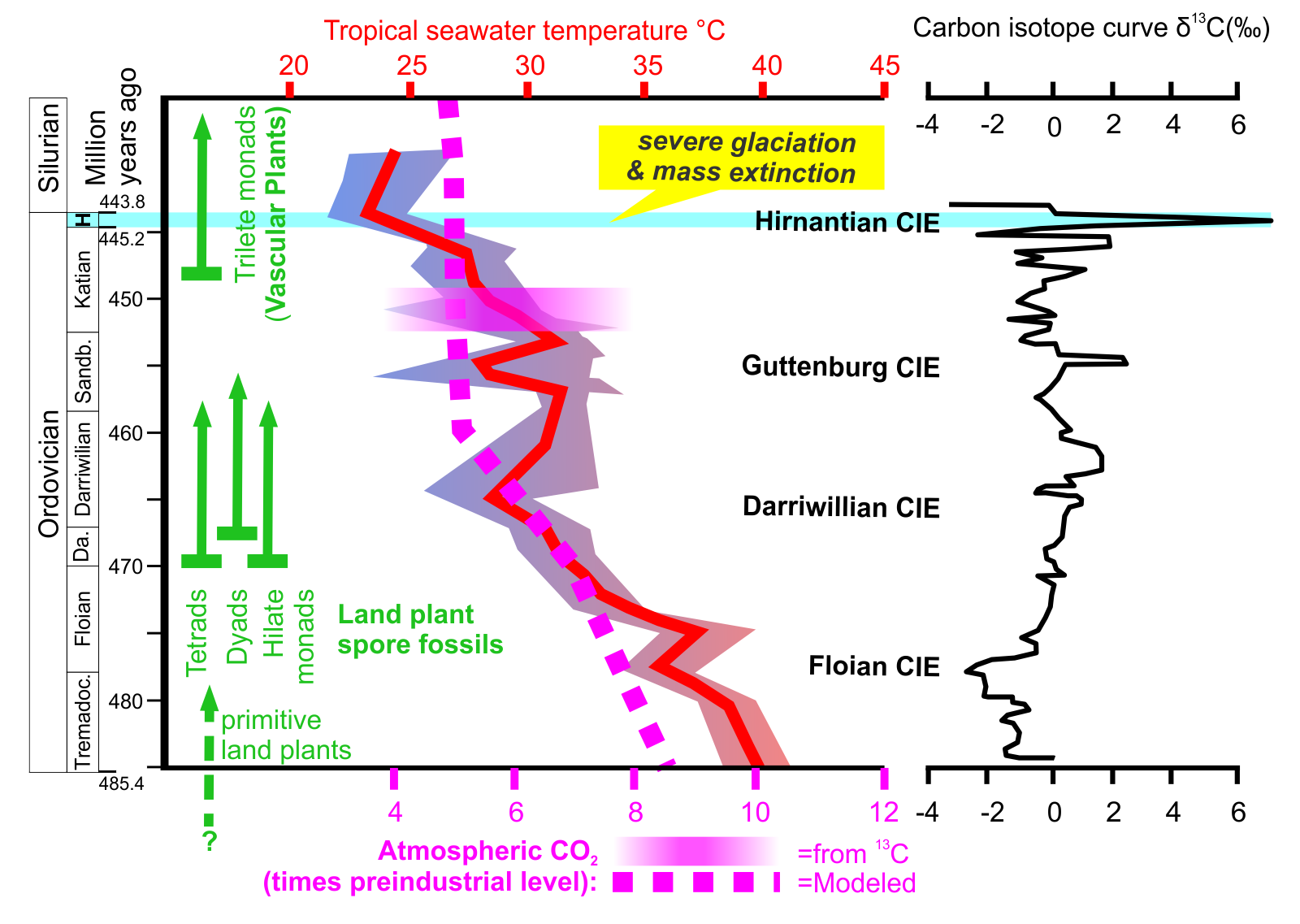
Cooling climate before the Hirnantian Mass Extinction. Cyan horizontal band is the Hirnantian Stage. Redrawn from Armstrong & Harper 2014. 13C-derived CO2 range from Pancost et al 2013, Plant spore first appearance simplified from Edwards et al 2014 and Rubinstein et al 2010.
Intermediate rebuttal written by howardlee
Update July 2015:
Here is a related lecture-video from Denial101x - Making Sense of Climate Science Denial
Last updated on 23 October 2015 by pattimer. View Archives







It is remarkable how rapidly the science has been moving in this area. In 2005, Dana Royer wrote:
That appears to be the point at which "skepictal" analysis of this issue stops. Genuine scientists kept on analyzing the issue. As noted above, Seth Young and coworkers made major contributions in 2009 and 2010, and now it is well accepted that there was a major carbon isotope excursion in the Hirnantian, coincident with the Hirnantian glaciation.
The magnitude of the C13 excursion can be seen by comparing it with the similar, but opposite signed excursion in the Paleo-Eocene Thermal Maximum, which was associated with greatly increased CO2 concentration.
First the PETM:
Then the Hirnantian:
(Please note the inverted scales for the C13 escursions.)
I feel like the evolution of land plants at the same general time of the Silurian-Ordovician glaciation is not a coincidence. It seems to me, this should have had a similar effect on climate as the initial evolution of plant life.
If these plants were to have drawn down atmospheric carbon into swamps and bogs which remained there until being digested by newly evolved animals or burned because of retreating water, this wouldn't show in the strontium signal, right?
How would it be possible to detect such an event? Would the ¹³C delta be higher because marine organisms were carbon-deficient and picking it up more frequently?
CBlargh @6, a large increase in the quantity of plants would show up in the fossil record as an increase in dC13 as the C12 isotope in CO2 was preferentially taken up in photosynthesis. The release of O2 by photosynthesis would also show up as elevated oxygen levels. However, this effect would have been very minor in the Ordivician when land plants were small, non-woody plants resembling liverworts, and mostly confined to shore lines, at least according to wikipedia.
However, as plants evolved and colonized the land, that is exactly what happened. At least, it was what happened until the evolution of land animals reduced the extent of forestation and reduced the time from photosynthesis to decay/metabolism, thereby restoring the balance:
@Tom: Thanks for your reply.
It looks from the chart that this occurred later. Is increased weathering the accepted cause of the dC13 spike during the Hirnantian?
Never underestimate the power of a liverwort!
CBlargh @8, I haven't really looked into it. Certainly it is plausible, and the Taconic orogeny occurs at about the right time to explain it. I do not, however, know the precise timing, nor what other events might be simultaneious with the Hirnantian cC13 excursion. Therefore it is a possible explanation only.
@Tom:
Wait! They may not be unrelated! I just read a paper suggesting roots increase weathering.
<a href = "http://www.pnas.org/content/98/8/4290.full.pdf">Falkowski and Rosenthal</a>
If the late Ordovician was the first time land rhizomes evolved, it would suggest to me it could have caused a pulse of calcium which pulled down atmospheric carbon in the sea, not necessarily in freshwater bogs through the land plants themselves.
CO2 at eight times preindustrial levels represents a forcing with respect to the preindustrial era of 11.1 W/m^2. A 4% reduction in solar activity represents a forcing of 9.52 W/m^2. The difference of 1.58 W/m^2 represents the net positive forcing relative to the preindustrial. For comparison, we currently have a radiative forcing more than 2.3 W/m^2 relative to the preindustrial.
Here is Scotese's map of continental configurations in the Ordivician:
Contrary to the main article, it does not show a continent over the South Pole.
What is important about the continental configuration is the lack of north/south oriented shorlines, particularly in the NH. That means ocean currents would have been diverted to polar regions far less than is currently the case. As a result, polar regions would have been warmer, and tropical regions hotter, all else being equal. That greater variation in temperature, however, means all else is not equal. Specifically, the greater the variation in temperature, the greater the intensity of outgoing radiation for the same mean temperature means in turn that the Earth will be cooler for the same radiative forcing, given greater variations in surface temperature. All in all, in modern terms that means the mean Ordivician conditions were effectively on the cusp of a new glaciation.
Against that is the high sea levels throughout the Ordivician (see also here):
The 120 meter plus Ordivician sea levels indicate that, all else being equal, typical conditions in the Ordivician were almost ice free. That should be taken with a grain of salt, however, as the change may be in part due to changes in the volume of the ocean basin.
The article says "During the Ordovician, solar output was 4% lower than current levels".
How strong is the evidence that solar output was lower during the Ordovician? Can you please point out to the evidence? Thank you in advance.
dueskept,
The 4% lower bit in the OP has an active link to Feulner (2012) in Review of Geophysics, 50 (2). Ther article contains multiple other references, that are themselves links.
dueskept... If I understand correctly, it's less about evidence than it is about physics. The Sun converts hydrogen to helium and as it does this, at very predictable rate, solar output increases.