





Latest GRACE data on Greenland ice mass
Posted on 28 May 2010 by John Cook
I don't plan to fall into the trap of breathlessly reporting every twist and turn of short-term climate fluctuations (I went through a bit of a silly period in March and April 2008). But we've been discussing Greenland trends and as it's been over a year since posting GRACE data on Greenland ice mass so I figure we're due an update. Many thanks to Tenney Naumer of Climate Change: The Next Generation who emailed me the graph. Thanks also to John Wahr at the University of Colorado who analysed the GRACE data and granted permission to reproduce it here. Figure 1 below shows the latest satellite gravity measurements of the Greenland ice mass, through to February 2010
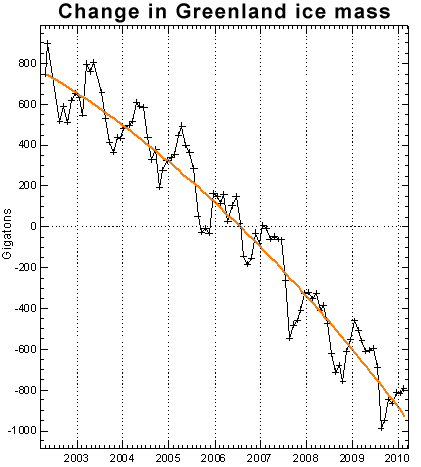
Figure 1: Greenland ice mass anomaly (black). Orange line is quadratic fit (John Wahr).
This graph includes 12 months more data than Velicogna 2009 and shows the rate of ice mass loss is still increasing. Of course, this is only over an 8 year period. You get a broader picture when you combine GRACE data with other estimates of Greenland mass balance. Figure 2 combines altimetry, net accumulation/loss, GRACE gravity data. It doesn't include GPS measurement although this is consistent with other results, also showing acceleration in recent years.
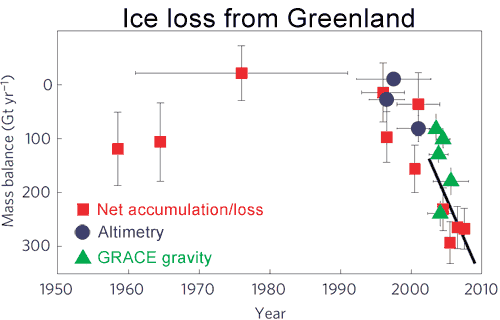
Figure 2: Rate of ice loss from Greenland. Vertical lines indicate uncertainty, horizontal lines indicate averaging time. Blue circles are from altimetry, red squares are from net accumulation/loss and green triangles are from GRACE. The black line is a straight-line (constant acceleration) fit through the mass balance data for the period 1996–2008 with a slope of 21 gigatonnes/yr2 (Jiang 2010).
What we find is over a longer time period, Greenland was in approximate mass balance in the early 1990s. Before then, data is sparse but may have been slightly increasing in mass during the mid-20th century.

Arguments


(wait did I say exciting!)
So perhaps we can take it as read that Greenland's got an accelerating mass deficit? That way-- in the upcoming inevitable discussion of why/how this has nothing to do with anthropogenic climate change-- we won't have to sift through a mass of previously failed "it's not shrinking/it's actually growing" hypotheses and stick w/somewhat more plausible alternate mechanisms not involving anthropogenic climate change. And how about those alternate ideas being posted here fully fleshed-out, with details of how they -ought- to work and then some confirmatory observations? Something remotely comparable to what John presents? That would be a really pleasant improvement.
(Sorry, somewhat out-of-patience here having listened for the past 24+ hours to BP's rapidly alternating stories about their oil leak while watching the video of the leak itself somehow remaining completely identical in appearance while it supposedly had tens of thousands of barrels of barite mud pumped into it, lost, shut off, then turned on again. I believe the mud's gone in, I guess, maybe, but I don't believe they had the well under control for any period of time.)
Yea cause is the Q isnt it... I believe recently that a shift in ocean currents is a contender as one of the major causes http://www.jpl.nasa.gov/news/news.cfm?release=2010-050
Whether this is a result/symptom of anthropogenic co2, or some other cause, i dont know, or pretend to know. But id put money on its the reason for the accelerating mass loss in recent times.
If you like to update such plots with recent historical data.. it would be great to have one collection of important history plots of various quantities, updated whenever new data comes available. You could even try to get the scales to match, so the plots line up so correlations between the histograms can be seen.
.. and yes: very nice to get preliminary data plotted here! I guess we should also accept the reality that those preliminary points might still change a bit, e.g. if some calibration of measurement data changes. If the status of the most recent points is as preliminary as I'm guessing.. maybe it is a good idea to give them a different color or symbol. That way, if they change in the future, nobody can blow that up to another pseudo-scandal-gate.
http://www.skepticalscience.com/What-CO2-level-would-cause-Greenland-ice-sheet-collapse.html
“Some of the more optimistic emission scenarios from the IPCC predict warming of 1 to 2°C. The last time temperatures were this high were 125,000 years ago. At this time, sea levels were over 6 metres higher than current levels (Kopp 2009).”
Four points:
1.... 6 metre sea level rise is way beyond what IPCC scenarios suggest will occur at +1 to 2c temp rise.
http://www.grida.no/publications/other/ipcc%5Ftar/?src=/climate/ipcc_tar/wg1/fig11-16.htm
2. It’s highly probably that even during the last 3,000 years there have been periods as warm as 1-2c greater than today without 6 metre increases in sea levels. That’s why it’s called Green Land. Melting around the coast and at low altitude is not unprecedented. Evidence for a Minoan Warm period of 3c warmer than today exists.
3. Even if true, why aren’t sea levels already much higher and rising faster than they are today? After all, it’s already warmed by at least .75c since 1900 that’s almost a third of the way there to 6 metre increases in sea level, but sea levels are only rising at 2-3mm a year. No consilience there.
4. The speed of current warming is also well within Holocene natural amplitudes. Both the Younger Dryas and The Akkadian Collapse occurred at rates that would have reduced modern civilization to rubble in a matter of years. In comparison today’s rate of warming is indeed mild. Although, that GRACE graphic is really scary looking!
Those IPCC predictions are for sea level rise by 2100. If you look at sea level prediction graphs, you'll note that sea levels are still rising sharply at that point. While you or I will probably not see beyond 2100, our grandchildren probably will. So there will be significant sea level rise beyond 2100 - it's just that the IPCC predictions don't go any further (to my knowledge). The timeframe of Kopp's 6 metre sea level rise is uncertain although other work indicates a timeframe of several centuries.
"Why aren’t sea levels already much higher and rising faster than they are today? After all, it’s already warmed by at least .75c since 1900 that’s almost a third of the way there to 6 metre increases in sea level"
The ice sheets have a great inertia - it takes a while for them to respond to the warming temperatures. In that sense, their great inertia is our friend. However, once they start disintegrating, it's not like we can throw a rope around the ice sheets and hold them back. At that point, the inertia becomes our enemy.
Well, except for the missing "it" or "ice" before "may", if we're to get really picky (I've been proofreading today, sorry).
1. Yes, you are correct about what the IPCC said, but the statement by Kopp is also correct. If I remember their paper, 125,000 years ago temps were sustained at a level 1-2C higher than today, and sea level was about 6 meters higher.
2. "periods as warm as 1-2c greater than today without 6 metre increases in sea levels"
First, how long is a "period", because it matters. If you mean years, then very likely there has been a year in the last 3000 years 1-2C warmer than this year. But a year is too short to matter (or measure in the paleo-record). Decade? Also too short to matter as far as sea level goes, and still too short to measure in the paleo-record. Centuries? Now measurable in the paleo-record, and more likely to matter for sea level but less likley to be true.
On both 1 and 2, I think the time over which temperatures remain warm clearly matters.
3&4. Good questions, but when you look at where the sea level rise comes from, it takes time unless you are having a massive ice sheet or two collapse. So your comparison is certainly true but not very useful, I think, because the first 10-15,000 years after Last Glacial Maximum were a very different situation than anything since sea level roughly stabilized about 6000 years ago.
replace discussion with discussing below
But we've been discussion Greenland trends and as it's been over a year since posting
regards and thanks
Tony
The main uncertainty to be resolved is time frame. The latest research indicates roughly 1 to 2 metres sea level rise by 2100 but it's difficult to say how quickly sea level rise will evolve after that. However, this uncertainty does not serve as a basis for inaction - quite the contrary.
Over in one of the other Greenland threads I show some figures that break down the "Greenland ice loss" budget into its various components. The figures are from van den Broeke et al. 2009.
And Doug is right that it's not really useful to say "Well, it would take a long time for the entire Greenland ice sheet to disappear." A loss of 10% of the ice would leave Greenland looking superficially more or less similar to its present appearance -- but it would add 65 cm to sea levels worldwide, which, combined with thermal expansion and contributions from Antarctica and mountain glaciers, would probably mean more than a meter of sea level rise. That's very problematic.
You're right that the real question is if (or, more realistically, how much) the current loss of ice will accelerate over the next few decades. If global warming stopped now and the rate of loss stayed at a constant 200-300 GT/year, it would take a very long time to send 10% of that ice into the ocean. In the more probable case where the planet continues to warm and the rate of ice loss continues to accelerate, this could happen at the century time scale.
As to the claims of temperatures more than 1-3 degrees warmer than today I say-cite your source! I've looked at numerous reconstructions, dating back as far as the end of the last glacial period, & the only time period that was apparently warmer than today was the so-called Climatic Optimum-around 12,000 to 8,000 years BP. Temperatures then were around 0.3 to 0.4 degrees warmer than the 20th C average (depending on which reconstruction you look at), but occurred over a period of *centuries*, not decades as is occurring now. Maybe the Mediterranean region was 3 degrees warmer during the Minoan period, than the *global* average today-but that's a purely *local* phenomenon & has no bearing on what global temperatures were like at that time (indeed, IIRC, much of North America & Northern Europe was very cold at this point in history-due to a slowdown in the Gulf Stream).
Unfounded myth? There are Viking graves that are still permafrost today. The graves weren't dug in permafrost.
[Let's stay in the correct hemisphere for this topic.]
Well, I guess that's more likely than a total melt by 2065 for a 7 metre rise, something that was once suggested here as an admittedly remote possibility once.
Still, the IPCC models projected for even the worst possible scenario shows less than 50cm sea level rise by 2100 and only 100cm rise by 2200 and that's the worst case scenario...perhaps more likely 20 to 30cm by 2100. Big margin there.
2 metre rise scenario isn't until 2330 or so.
So, I guess your interpretation of the latest data disagrees with the IPCC worst possible scenario by a factor of 2 to 4?
http://www.grida.no/publications/other/ipcc%5Ftar/?src=/climate/ipcc_tar/wg1/fig11-16.htm
More recent research in fact indicates an acceleration of the wasting process in Greenland. That's why what you see reported on sites such as SkS may appear different than the 4th IPCC assessment.
As an exercise, you might compare the 3rd report w/the 4th.
a superficial look at the papers may be misleading. The IPCC does not consider ice sheet melting at all. The 50 cm by 2100 are then, explicitly, a lower bound.
Meanwhile AMSU-A is still looking scary. I was rash enough to blog about it in April and it's still not disappointing. The thing is, we aren't meant to obsess about short-term changes because natural variability will overwhelm the long-term trend if we look at too short a period, but natural variability should be pushing temperatures down not up over this period.
I'm expecting someone to steal Spencer's email any day now.
In post # 18 I tried to introduce evidence that the MWP was global in extent and as warm or warmer than today but it got snipped out by our moderator....
So I am reduced to saying only that because there is evidence that the MWP was as warm or warmer than today and no "tipping" point was reach causing the icecap to slip away as some have suggested it might, there is no reason to believe that it will do so today, other than a 7-year long scary-looking graphic in the 20,000 year history of the Greenland icecap.
My own bias here is towards the conception of the Greenland icecap as a relatively robust interglacial feature of the Earth's geophysiology. If it were so susceptible to succumb to temp perturbations only very slightly higher than today it's unlikely to have survived the last 8,000 years so intact.
Put another way, what leads you to believe Greenland's ice is so robust as to be unresponsive to small changes in its environment and controls?
I suggest instead that all the actual evidence we've been shown-- are indeed recording now-- indicates that ice on Greenland is quite responsive to its surrounding conditions, does not in fact have any degree of "robustness" at all. The ice sheet is no larger or smaller than it must necessarily be in the context of its surroundings.
Greenland's ice is not an engineered object. It is an emergent feature of its environment. What would be entirely surprising would be to find that as such it is somehow decoupled from its external conditions.
As Marcus points out concern for a catastrophic collapse of Greenland's ice sheet is based primarily upon the assumption that modern warming is anomalous, indeed unprecedented in the Holocene. This is a testable assumption.
I don't get this sense in the peer-reviewed literature. The concern for collapse of Greenland's ice sheet comes from the fact that when the Earth was 1 to 2 degrees warmer than now, sea levels were at least 6 metres higher than now. These higher sea level weren't because temperatures changed quickly during the last interglacial 125,000 years ago but due to sustained warmer temperatures.
How do you draw the conclusion that our concern for ice loss on Greenland is based on the fact that modern warming is anomalous? For most of us the issue is that the ice is in fact melting, which is not an assumption.
"Akkadian Collapse" - I know little about this but isnt this sudden onset of drought? What evidence that this was a global event rather than regional? I would take very little comfort from this or other records of regional disruption of the hydrological cycle. Rapid change from whatever reason is difficult to adapt to and the fact the AGW predicts more disruptions like this in various parts of the worlds is worrying.
The real issue is that unlike past natural variations, we expect warming to continue or even accelerate unless we reverse changes to atmospheric composition. It is what happens to this in future that will determine the fate of greenland ice sheet.
Why not look at more recent warming, say like in the last 4,000 years? In the recent era surely many variables would be more tightly coupled to today than data from 125,000 years ago and have a higher resolution. Sure, there are no periods of recent past warming above today's temperature longer than a few centuries, perhaps even less. But our concern is melting over the next few decades rather than millennia.
Why indeed look back 125,000? Because of the assumption that no recent past record of warming 1c to 2c higher than today exists. No? Certainly, Greenland didn’t melt much during recent warm periods. Ie, concern for a catastrophic collapse of Greenland's ice sheet is based primarily upon the assumption that modern warming is anomalous, indeed, unprecedented in the Holocene.
So we got to go back 125,000 years to find a period where the sea-level was 6 plus meters higher than today? I find that an argument for the relative robustness of Greenland’s icecap rather than evidence that a 100,000 year old feature is likely to disappear rapidly due to a 1c to 2c temperature rise.
Greenland didn't disappear 100,000 years ago - it's been around for at least half a million years. Using very rough back-of-the-napkin calculations, 6 metres sea level rise would receive perhaps 3 metres sea level rise from Greenland which would be less than half of the ice mass currently on the ice sheet. This is very roughly speaking, I'm not aware of the relative contributions from Antarctica versus Greenland.
The issue here isn't the total disintegration of Greenland (at least I hope it doesn't come to that). But even a partial collapse of the Greenland ice sheet will impose sea level rise in the order of metres plus a corresponding sea level rise from Antarctica (throw in melting glaciers and thermal expansion for good measure).
Why would one cite evidence from 125,000 years ago, an entirely different era than the holocene?
Indeed. Take a look at John's post, above. Notice the graph, showing an accelerating loss of ice, now. Nice, fresh data, no interpretation required.
Why not look at more recent warming, say like in the last 4,000 years?
How about going one better, and looking at the warming happening now? Warming, ice melting. What could be simpler?
Wes, the ice sheet is melting right now, responding to a change in regime. What we know of the cause for that change suggests it's going to last for a long time.
As John and others have mentioned, the issue is not that the ice sheet is going to vanish, not now and not in our great-grandchildren's time. That's not the salient issue so don't worry about it. Worry instead about how to arrest the decline we're seeing now.
Fine. What we need are testable assumptions. Not strawmen.
Speaking of strawmen, I understand that the real concern is the possibility that about 7% of the ice might melt by say 2090 leading to a one meter rise in sea levels, even though the current melt rate in the graph above if it continues uninterrupted indicates a sea level rise of 1 metre around in around 800 years. We've been through all that and it leads back to the whole unprecedented, anomalous warming meme.
Because, if today's warming isn't anomalous and unprecedented then we could simply look at other warm periods in the recent holocene for guidance. Right?
Moreover, even if today's relatively ordinary rate of warming (0.8c per century) is 100% anthropocentrically induced we won't be 1-2c warmer before 2080 to 2150. Surely, you don't doubt that peak oil-which is forecasted for virtually tomorrow- combined with exponentially accelerating technological evolution won't have pushed us well past a hydrocarbon-based economy long before then?
...even though the current melt rate in the graph above if it continues uninterrupted indicates a sea level rise of 1 metre around in around 800 years.
Did you notice, the graph John displayed is curved, in the wrong direction?
Surely, you don't doubt that peak oil-which is forecasted for virtually tomorrow- combined with exponentially accelerating technological evolution won't have pushed us well past a hydrocarbon-based economy long before then?
A moving goal post we can agree on, and upon which I've got my hopes pinned.
I also mentioned that’s strawman. But now that you bring it up: There was a post on this site that suggested if these trends not only continued on this very short slope but accelerate exponential then Greenland’s icecap will be gone in 65 years! To be fair the post mentioned that was unlikely, but still thought the possibility was worth a mention. However, the post has been modified over the weekend. Down the memory hole! Anyway, that’s where I got the idea that someone here might possibly believe in the imminent failure of Greenland’s icecap....within our children's lifetime! Silly me.
Wes, let me help you plug your memory hole. The post you refer to is this one, still plainly in sight. It's an elliptical reference to a rhetorically witty but unproductive analysis found on a website not overly concerned with useful science.
As you say, silly you, heh!
No - but because business as usual scenarios will cause more warming into a system still out of equilibrium. On the other hand Gareth's little graph gives you a perspective on modern temperature compared to rest of Holocene for greenland.
I certainly hope you are right about peak oil etc. but looking into past for when atmosphere was last at 450ppm, then sea level was hell of lot higher suggesting a long way to equilibrium. For questions as too how fast sealevel CAN rise from all sources, then perhaps look at Vermeer & Rahmstorf 2009.
As Doug Bostrom points out, the comment of mine that you're referring to is right here.
I thought the point was obvious -- extrapolating the past decade's accelerating rate of ice loss leads to a physically unrealistic result (all ice gone by 2075) and thus is unreasonable. There is no realistic process that could ablate that much ice from that physical setting in that short a time.
My second point was that even a much slower acceleration than we're seen over the past decade would still have disastrous results. A much slower acceleration might leave 90% of Greenland's ice still intact in 2100, but would also contribute to a greater than one meter rise in sea level when combined with thermal expansion and loss of ice from West Antarctica and alpine glaciers.
Sea level is one area where the IPCC forecasts have clearly been too cautious (see here and here).
Where do you get that "2080 to 2150" from? Pretty much all the emissions scenarios (except the obviously unrealistic "Year 2000 constant concentrations") give 1-2 C warming by the middle of this century. Don't make the mistake of just projecting forward the 0.8 C we've experienced so far -- even if we capped emissions right now (which isn't going to happen), the rate would increase beyond that 0.8C per century because of additional warming in the pipeline thanks to slow feedbacks.
IMHO, it's the rigorous and even-handed enforcement of that policy that has kept this site readable while the number of visitors has skyrocketed over the past year.
I'm not bothered by wg's claim that my comment was deleted; I'm bothered that he completely misinterpreted it ("that’s where I got the idea that someone here might possibly believe in the imminent failure of Greenland’s icecap....within our children's lifetime! Silly me.")
Comments there welcome.
BTW, I can always tell when someone grabs pics from my site by the telltale bolded, Arial heading added above the graph :-)
The matter you mention of folks taking comfort from upticks since 2007 truly baffles me; the briefest scrutiny of past years' data reveals a monotonous succession of similar dips and rises, overwhelmed by an equally monotonous but much large ongoing slump. Blind men groping an elephant comes to mind.
Doug #46, I don't interrogate the reasons for people taking comfort from irrelevant short-term variation, I merely destroy their hopes (and mine: it would be great if they were right). Meanwhile AMSU-A continues showing 2010 to be anomalously warm, given short-term effects. Let's hope the straw-clutchers let go soon enough for us to take effective action.
I'm changing my focus to talking up clean energy because I am convinced most people arguing against the science don't really understand it and are motivated more by fear that the alternative is a collapse of industrial society.





