Is Antarctica losing or gaining ice?
What the science says...
| Select a level... |
Basic
|
Intermediate
| |||
|
While the interior of East Antarctica is gaining land ice, overall Antarctica has been losing land ice at an accelerating rate. Antarctic sea ice is growing despite a strongly warming Southern Ocean. |
|||||
Climate Myth...
Antarctica is gaining ice
"[Ice] is expanding in much of Antarctica, contrary to the widespread public belief that global warming is melting the continental ice cap." (Greg Roberts, The Australian)
Antarctica is a continent with 98% of the land covered by ice, and is surrounded by ocean that has much of its surface covered by seasonal sea ice. Reporting on Antarctic ice often fails to recognise the fundamental difference between sea ice and land ice. Antarctic land ice is the ice which has accumulated over thousands of years on the Antarctica landmass through snowfall. This land ice therefore is actually stored ocean water that once evaporated and then fell as precipitation on the land. Antarctic sea ice is entirely different as it is ice which forms in salt water during the winter and almost entirely melts again in the summer.
Importantly, when land ice melts and flows into the oceans global sea levels rise on average; when sea ice melts sea levels do not change measurably but other parts of the climate system are affected, like increased absorbtion of solar energy by the darker oceans.
To summarize the situation with Antarctic ice trends:
- Antarctic land ice is decreasing at an accelerating rate
- Antarctic sea ice is increasing despite the warming Southern Ocean
Antarctic Land Ice is decreasing
Measuring changes in Antarctic land ice mass has been a difficult process due to the ice sheet's massive size and complexity. However, since the 1990s satellites have been launched that allow us to measure those changes. There are three entirely different approaches, and they all agree within their measurement uncertainties. The most recent estimate of land ice change that combines estimates from these three approaches reported (Shepherd and others, 2012) that between 1992 and 2011, the Antarctic Ice Sheets overall lost 1350 giga-tonnes (Gt) or 1,350,000,000,000 tonnes into the oceans, at an average rate of 70 Gt per year (Gt/yr). Because a reduction in mass of 360 Gt/year represents an annual global-average sea level rise of 1 mm, these estimates equate to an increase in global-average sea levels by 0.19 mm/yr, or 1.9 mm per decade. Together with the land ice loss from Greenland, this represents about 30% of the observed global-average sea level rise over this period.
Examining how this change is spread over time (Figure 1) reveals that the ice sheet as a whole was not losing or gaining ice in the early 1990s. Since then ice loss has begun, and is clearly seen to have accelerated during that time:
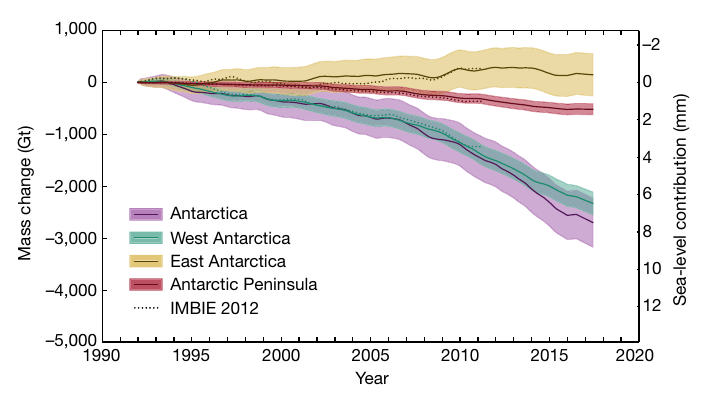
Figure 1: Estimates of total Antarctic land ice changes (bottom) and regions within it (top) and approximate sea level contributions using a combination of several different measurement techniques (Shepherd and others, 2012). Shaded areas represent the estimate uncertainty (1-sigma).
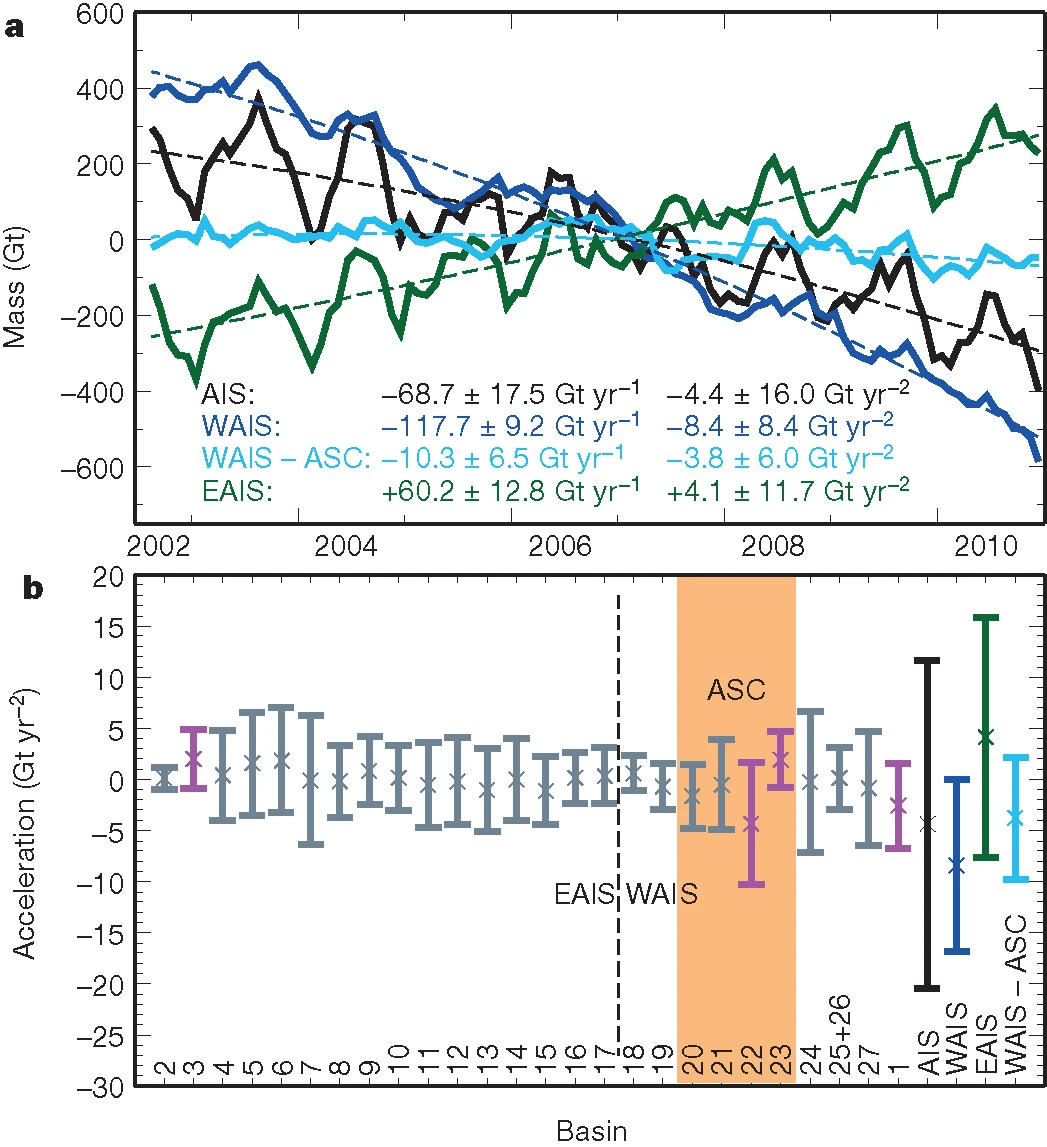
The satellite mission that is best suited to measuring land ice mass change is the Gravity Recovery and Climate Experiment (GRACE). The GRACE satellites measure changes in Earth's gravity and these can be directly related to surface mass variations such as the Antarctic ice sheet. Recent GRACE estimates of mass change show the dramatic mass loss in West Antarctica and mass gain in East Antarctica (King and others, 2012):

Figure 2: a, GRACE estimate of ice-mass change (2002-2012), with ice drainage basins numbered (boldface italics where trends are statistically different to zero with 95% confidence). b, c, Basin-specific lower and upper bounds on ice-mass change, respectively, reflecting the potential systematic error in the basin estimates (King and others, 2012).
The East Antarctic Ice Sheet is growing slightly over satellite period (Figures 1&2) but not enough to offset the other losses. It is not yet clear if the increase in mass in Antarctica is a short-term phenomena due to a particularly snowy period (Boening and others, 2012) or if it is a long-term trend. Increased snowfall in East Antarctica has long been predicted in a warming climate, so this is an important region to continue monitoring.
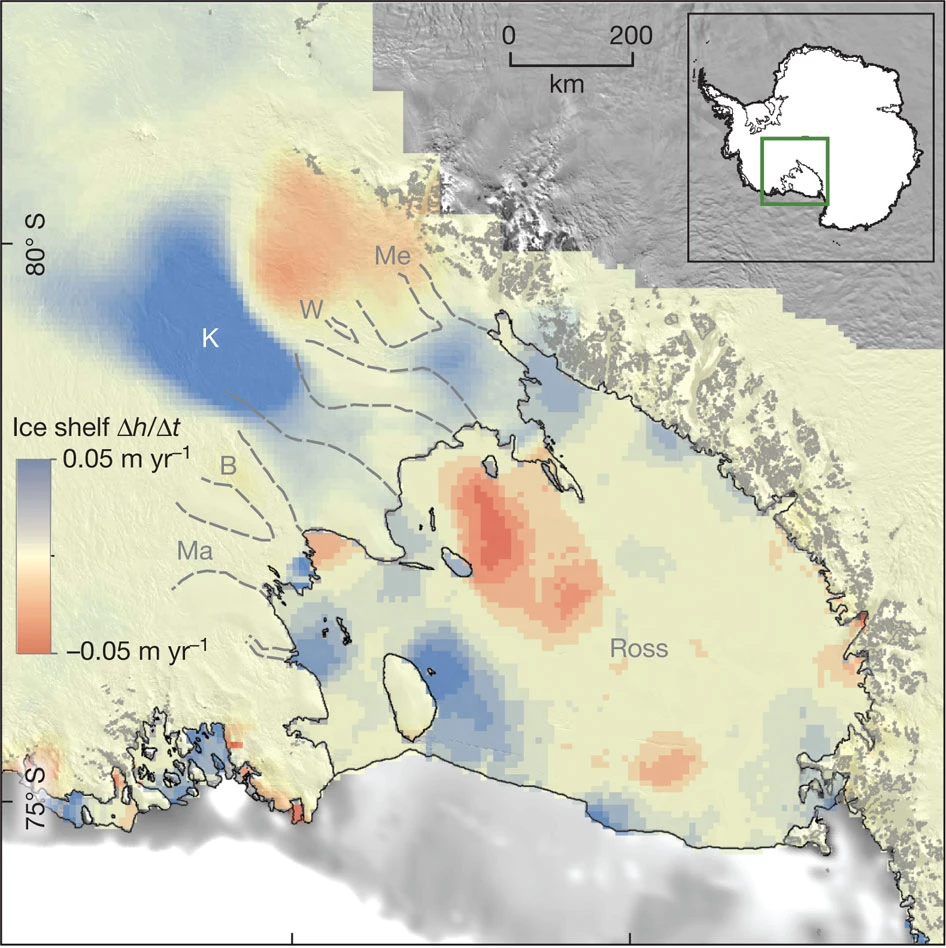
The land ice loss from the West Antarctic Ice Sheet is not due to surface melting, as the summer temperatures in Antarctica are generally always below freezing, and measured changes in precipitation cannot explain it either. Instead, the melting is occuring due to warm ocean water melting the land ice around its edges, resulting in a spreading of this ice loss inland:

Figure 3: Rates of lowering of land ice and its floating extensions in West Antarctica, 2003–2008 (Pritchard and others, 2012). Floating extensions of the land ice (ice shelves) that are labelled are Venable (V), Abbott (A), Cosgrove (C), Pine Island (PI), Thwaites (TH), Crosson (CR), Dotson (D), Getz (G), De Vicq (DV), Land (L), Nickerson (N) and Sulzberger (SZ). Arrows highlight areas of slow-flowing, grounded ice. Bathymetry landward of the continental-shelf break is in greyscale. The divide between floating and grounded ice is shown in white. The inset shows the location of the figure (green box) overlaid on the outline of Antarctica.
The influx in warm water onto the continental shelf in this region is not entirely understood but is probably at least partly linked to increased westerly winds that have occured as a result of reduced stratospheric ozone levels since the mid-20th Century (Gillet 2003, Thompson 2002, Turner 2009).
The Antarctic ice sheet plays an important role in the total contribution to sea level. That contribution is continuously and rapidly growing.
Antarctic Sea Ice is increasing
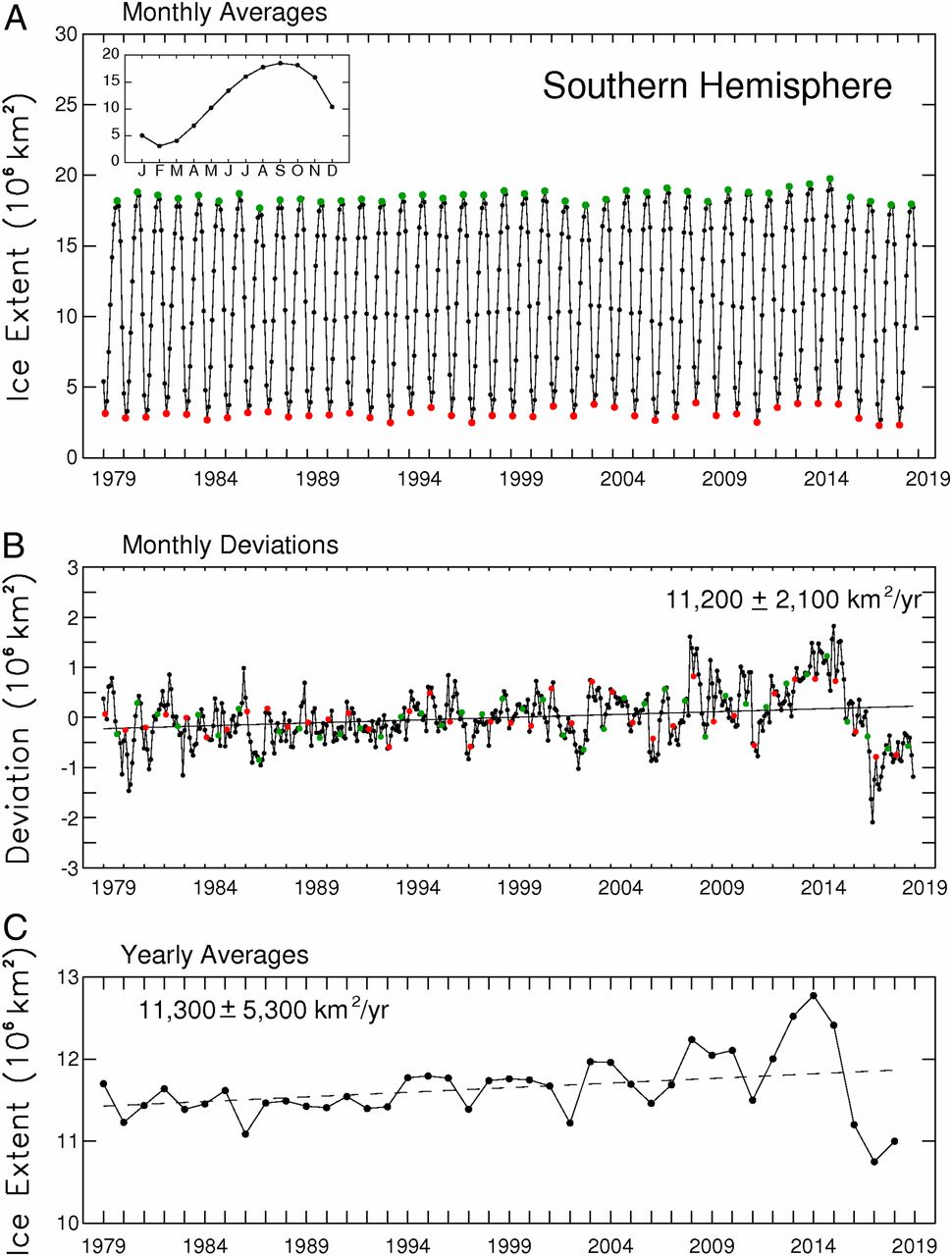
Antarctic sea ice has shown long term growth since satellites began measurements in 1979. This is an observation that has been often cited as proof against global warming. However, rarely is the question raised: why is Antarctic sea ice increasing? The implicit assumption is it must be cooling around Antarctica. This is decidedly not the case. In fact, the Southern Ocean has been warming faster than the rest of the world's oceans. Globally from 1955 to 1995, oceans have been warming at 0.1°C per decade. In contrast, the Southern Ocean has been warming at 0.17°C per decade. Not only is the Southern Ocean warming, it is warming faster than the global trend.
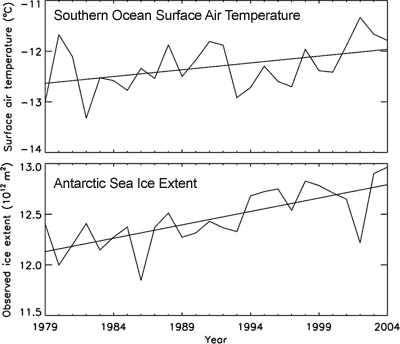
Figure 3: Surface air temperature over the ice-covered areas of the Southern Ocean (top). Sea ice extent, observed by satellite (bottom). (Zhang 2007)
If the Southern Ocean is warming, why is Antarctic sea ice increasing? There are several contributing factors. One is the drop in ozone levels over Antarctica. The hole in the ozone layer above the South Pole has caused cooling in the stratosphere (Gillet 2003). This strengthens the cyclonic winds that circle the Antarctic continent (Thompson 2002). The wind pushes sea ice around, creating areas of open water known as polynyas. More polynyas lead to increased sea ice production (Turner 2009).
Another contributor is changes in ocean circulation. The Southern Ocean consists of a layer of cold water near the surface and a layer of warmer water below. Water from the warmer layer rises up to the surface, melting sea ice. However, as air temperatures warm, the amount of rain and snowfall also increases. This freshens the surface waters, leading to a surface layer less dense than the saltier, warmer water below. The layers become more stratified and mix less. Less heat is transported upwards from the deeper, warmer layer. Hence less sea ice is melted (Zhang 2007). An increase in melting of Antarctic land ice will also contribute to the increased sea ice production (Bintanga et al. 2013).
In summary, Antarctic sea ice is a complex and unique phenomenon. The simplistic interpretation that it must be cooling around Antarctica is decidedly not the case. Warming is happening - how it affects specific regions is complicated.
Last updated on 4 November 2014 by mattking. View Archives
Arguments


Basic
Intermediate


"NOx destroys ozone in catalytic reaction cycles; and when you change ozone in the stratosphere, that... can then feed down to surface temperatures."
From an article by BBC News "More doubt on cosmic climate link By Richard Black, Environment correspondent, BBC News website, Vienna" under the subhead Local change
I noticed the ozone portion because it rang a bell fro what I had read previously in Mackeys paper.
http://arctic.atmos.uiuc.edu/cryosphere/IMAGES/current.area.south.jpg
The Arctic doesn't seem to be doing so bad anymore, also:
http://arctic.atmos.uiuc.edu/cryosphere/IMAGES/current.area.jpg
http://www.jpl.nasa.gov/news/news.cfm?release=2008-010
Antarctic ice is increasing.
In addition to the cryosphere link provided Anthony,
This is confirmed by NSIDC,
http://nsidc.org/data/smmr_ssmi_ancillary/regions/total_antarctic.html
by NCDC,
http://www.ncdc.noaa.gov/oa/climate/research/2008/apr/global.html#seaice
and by numerous scientific papers, including
Cavalieri and Parkinson, J. Geophys. Res. 113, C07004 (2008),
Comiso and Nishio, J. Geophys. Res. 113, CO2S07 (2008).
You have managed to find one paper that finds a decrease - but that only covers a 3 year period! Obviously you cannot get a significant trend from 3 years data.
A team of NASA and university scientists has found clear evidence that EXTENSIVE areas of snow melted in west Antarctica in January 2005 in response to WARM TEMPERATURES. This was the first WIDESPREAD Antarctic melting ever detected with NASA's QuikScat satellite and the MOST SIGNIFICANT MELT observed using satellites during the past three decades. Combined, the affected regions encompassed an area as big as CALIFORNIA."
My caps. - just look at the map and tell me the use of those words is justified. The ACTUAL area involved is a FRACTION of the ice sheets, even the IPCC reckon it would take over 1000yrs to melt if the worst of their predictions materialised.
http://www.slate.com/id/2192730/
. . . No one's entirely sure what's causing the expansion of sea ice in Antarctica, but the likeliest explanation is a disturbing one. According to a 2005 NASA-funded study, warmer temperatures have caused greater snowfall around the continent's edges, where the open oceans provide plenty of raw material for precipitation. (Warmer air absorbs moisture more readily.) The weight of that excess snow pushes sheets of sea ice down into the water, causing more water to freeze.
The incremental expansion of Antarctica's sea ice has coincided with some more troubling changes. Four of the continent's largest glaciers (whose fates are largely unrelated to that of sea ice) are retreating rapidly, and researchers blame increases in ocean temperature. The diminishment of such massive glaciers means that, despite the slow creep forward of the continent's sea ice, the total mass of all Antarctic ice—which includes inland ice—has experienced a marked decrease. And a continuation of that trend could lead to significant rises in global sea levels. Furthermore, snow is melting much farther inland than ever, as well as high up in the Transantarctic Mountains. . .
Chill, amigo (no pun intended).
The article makes the distinction right off the bat between land ice and sea ice. Your two links discuss SEA ICE. We know there's been an increase in sea ice.
In a place where the temperature is always well below freezing, "global warming" is not going to melt all the ice. That doesn't mean it isn't a problem elsewhere. Even if there were no net ice loss on earth, if we're losing ice in places we need it (such as mountain ranges that supply people with drinking water), and accumulate it in places that have no humans at all (Antarctica), that's an enormous problem.
The persistence of climate change skeptics in using Antarctica to say "look, everything's ok", is really beyond absurd.
That's just silly. By moving the range a couple points in either direction you could get a trend going any way you want.
Meanwhile, there's a 20-year graph that confirms Antarctica appears to be gaining mass:
http://www.gsfc.nasa.gov/topstory/20020820southseaice.html
And, the precise extent may be somewhat lower than presented:
Geodetic measurements of vertical crustal velocity in West Antarctica and the implications for ice mass balance
Received 20 May 2009; accepted 28 August 2009; published 13 October 2009.
Citation: Bevis, M., et al. (2009), Geodetic measurements of vertical crustal velocity in West Antarctica and the implications for ice mass balance, Geochem. Geophys. Geosyst., 10, Q10005, doi:10.1029/2009GC002642.
"We present preliminary geodetic estimates for vertical bedrock velocity at twelve survey GPS stations in the West Antarctic GPS Network, an additional survey station in the northern Antarctic Peninsula, and eleven continuous GPS stations distributed across the continent. The spatial pattern of these velocities is not consistent with any postglacial rebound (PGR) model known to us. Four leading PGR models appear to be overpredicting uplift rates in the Transantarctic Mountains and West Antarctica and underpredicting them in the peninsula north of 65°. This discrepancy cannot be explained in terms of an elastic response to modern ice loss (except, perhaps, in part of the peninsula). Therefore, our initial geodetic results suggest that most GRACE ice mass rate estimates, which are critically dependent on a PGR correction, are systematically biased and are overpredicting ice loss for the continent as a whole."
We should also note that the corrections applied by Bevis et al. (2009) suggest that a bias in ice mass loss from GRACE measurements amounts to ~33 Gt/yr [**]. This is a significant, but small, proportion of the total Antarctic ice loss determined by GRACE (see figures in John Cook's summary above):
[*] E. Rignot et al. (2008) Recent Antarctic ice mass loss from radar interferometry and regional climate modelling Nature Geoscience 1, 106 - 110 (2008)
[**]Bevis et al. (2009) para [19]; page 9:
The authors (Bevis et al, 2009) also point out that GRACE should make reliable estimates of any further enhanced acceleration in ice mass loss (or sudden jumps in ice mass loss), since the post-glacial rebound (that has to be corrected for in mass change estimations) doesn't vary much on the interannual timescale.
Another thing I am wondering about, is the net effect of the situation underlying the (rather slow) increase in sea ice. Albedo should be increasing a little bit, but what about the heat loss from sea? Could the extra warming of the sea and the increasing sea ice be two aspects of the same circulatory phenomenon? Maybe a stupid question, I'm not very much into this :-)
As for the slow increase in Antarctic sea ice over the past few decades, I don't really have much insight into that. It seems somewhat counter-intuitive, but if the evidence is sufficiently strong that sea ice has grown somewhat while ocean and air temperatures have increased, then we may as well accept for now what the science says in relation to deep Southern ocean stratification and the effects of the ozone hole...although I guess in this case that there's more t be learned on this little piece of natural phenomena.
Just to point out that similar work has been done for Eastern anarctic, here, with similar conclusions. Suggesting further error in the previous ice mass estimates including Velicogna 2009. This publication suggests the green line in Fig1 should maybe showing a gain over time.
I'd highlight the second half of the Bevis quote in #12 which states that the 33Gt yr-1 is only a provisional figure (and covers only part of Western Antarctic)
I'd be keen to see some full estimated that take into account the GPS data.
in the Zhang 2009 paper cited, the wind field is taken from the NCEP-NCAR reanalisys. It's not shown nor I looked for it; but given that the surface temperature has increased (fig. 3 in this post) I don't think that there any significant large scale change in thermal winds at play. Locally and seasonally it might have an effect but i have no clue on this.
Surface snowmelt in Antarctica in 2008, as derived from spaceborne passive microwave observations at 19.35 gigahertz, was 40% below the average of the period 1987–2007. The melting index (MI, a measure of where melting occurred and for how long) in 2008 was the second-smallest value in the 1987–2008 period, with 3,465,625 square kilometers times days (km2 × days) against the average value of 8,407,531 km2 × days (Figure 1a). Melt extent (ME, the extent of the area subject to melting) in 2008 set a new minimum with 297,500 square kilometers, against an average value of approximately 861,812 square kilometers.”
This evidence suggests that Antarctica, where 90% of the land based ice in the world resides, is increasing in mass.
You're also correct in pointing out that snow accumulating in the East Antarctic interior is increasing, presumably due to increased precipitation caused by more humid conditions caused by warming air. That Antarctica is losing mass at an accelerating rate while gaining mass in the interior is a testament to the sensitive nature of ice sheet dynamics - ice sheets are proving more sensitive than previously realised and are sliding into the oceans at a faster rate.
This is also borne out by paleo studies that have looked at ice sheet and sea level behaviour in the past and found sea levels to be over 6 metres higher than current levels when temperatures were only 1 to 2 degrees warmer than now. Multiple lines of evidence point to the same answer - the ice sheets are sensitive to warming temperatures and are going to cause significant sea level rise over this century (and beyond).
Your argument is incomplete. You need to account for the GRACE data shown above and in any case the single year you cite is inadequate as a suggestion that the Antarctic ice sheet is trending upward in mass.
Also, would you mind providing a citation for your quote?
Its lunacy to claim one can measure the whole Antarctic thickness with a few millimeter accuracy. And even if one could - there is NO CONTEXT for the claimed ice loss.
Also i'd like to point out that "glacier melting" is no evidence to claim that global warming is still happening (NOR that its man made). If you take ice out from the freezer to the room temp, it will continue melting even if the room temp stays constant. Same happens now with the glaciers - temperatures rose sharply in the late 1990's and have stayed almost at constant since (even slight cooling both ARGO and UAH show this).
Actually, what GRACE does is measure distortions in the earth's gravity field over broad areas and long periods of time. This can't tell you what the exact elevation of the ice surface at point X was on date Y, but it can give you a very precise estimate of regional-scale, long-term changes in ice mass. You really should make an effort to understand how things work before throwing around accusations of "lunacy".
I'm not sure what you mean by "NO CONTEXT". The context is that anthropogenic emission of greenhouse gases creates an energy imbalance between the earth and its exoatmospheric environment, in turn producing a net increase in heat content of the climate system. This has resulted in warming of the Southern Ocean around Antarctica, a reduction in the mass of ice shelves, and an increase in the rate of ice discharge from the continent into the ocean.
As additional context, this is all occurring at a time when the planet is near the "warm" peak of its glacial/interglacial cycle, so rather than, say, moving us from a glacial to an interglacial climate, this anthropogenic warming is moving us from an interglacial climate to a condition the earth has probably not experienced in millions of years.
You're right. If we had no other evidence that fossil fuel combustion produces CO2, and no other evidence that CO2 absorbs infrared radiation, then we wouldn't be able to conclude that anthropogenic greenhouse gases were warming the earth just from measuring glacier retreat alone.
Fortunately, we have a great deal of evidence that already resolves these points. The loss of ice from glaciers and polar ice sheets is important for two reasons:
(a) as an additional source of confirmation that demonstrates agreement with the many other lines of evidence of climate change, and
(b) as an important consequence of climate change that will have large negative impacts on our economy and on social welfare in many countries by increasing sea levels.
There are many references to be found on the Internet, linked to valid scientific journals citing the rapid growth in the vast majority of the Antarctic landmass. I will leave it up to you to find them.
In response to the author's response to mt comment:
Being a geologist that has undertaken many gravity surveys, I am hesitant to make any interpretation based on aggregated data as you have done. It implies that the observed decrease is consistent throughout whereas that is likely not the case. You will get melting on the fringes and accumulation in the center - but the ice forming through the accumulation of the snow in the center is not the same as the ice that is melting on the fringes, which by the way shows a significant increase in ice mass from 2004.5 to 2005.5 suggests something else is happening or the data needs to be reviewed.
The other point I will make is that a five year trend analysis,
In addition,
Many references, but you won't cite any? Not even the one you quoted which I might add without a cite is not cricket, either; the authors I'm sure would appreciate attribution.
From your further comment I take it that aggregated data is insufficient but a single year of data is?
I don't find your approach persuasive.
"You're right. If we had no other evidence that fossil fuel combustion produces CO2, and no other evidence that CO2 absorbs infrared radiation, then we wouldn't be able to conclude that anthropogenic greenhouse gases were warming the earth just from measuring glacier retreat alone."
So CO2 traps heat, whats the big news? Thats only a half-truth like we all know its all about feedbacks: we dont even know if they start with a + or -. But that's another topic.
Ned wrote:
"Actually, what GRACE does is measure distortions in the earth's gravity field over broad areas and long periods of time. This can't tell you what the exact elevation of the ice surface at point X was on date Y, but it can give you a very precise estimate of regional-scale, long-term changes in ice mass. You really should make an effort to understand how things work before throwing around accusations of "lunacy"."
Ok, I was obviously wrong about that and thank you for clarification. Note that I used the term "lunacy" with the question about capability to measure 7mm differences on ice thickness, not with other possible methods.
But back to the point, there are another theories for glacier melting and one is the black soot. The Lawrence Berkeley Lab concluded in their recent study
http://newscenter.lbl.gov/feature-stories/2010/02/03/black-carbon-himalayan-glaciers/
that black carbon is the most significant factor on the melting Himalayas. There are other studies as well which conclude aerosols have a significant role on observed glacier changes and that increasing temperatures are not nearly enough to explain it.
About context I mean we have no idea how much Ice mass Antarctica had in the 30's or how much there was ice on the 70's. Or how much variability there was between those periods. Just a 8 year trend is completely uninformative and the seen changes can be as well natural oscillation, the context would clarify this. Yet we have no context so the measurements from GRACE still tells us almost nothing.
If the "warming oceans" (where actually our highest quality ARGO-data shows a slight cooling) were the reason for ice mass loss in Antarctica there would be also no increase in the sea ice. But for some reason sea ice still increasing.
I bet that the most affecting factors considering glaciers are the black soot and changes in rainfall. Rising temperatures might even have an ice thickening results since in most glaciers the temps are really much below 0C most of the year and increased temps mean more snow - more ice. Where Himalayas might retreat from the lower reagions - the upper regions are expected to increase in thickness.
Some of the points were a bit offtopic but I hope you dont mind.
Greets,
protestant
You're right that there aren't sufficient data to construct a mass balance for Antarctica in the 1930s, or any time before the International Geophysical Year (and estimates from before the launch of GRACE will have much wider confidence intervals). But most of that uncertainty is in the accumulation side, not the ice loss side, where there's a reasonable degree of confidence that ice loss has been accelerating. Thus, for example, a series of ice shelves on the Antarctic peninsula have partially or fully disintegrated over the past two decades, all of which managed to survive the 1930s. And in recent years these effects have been moving progressively further south, an additional confirmation that warming is accelerating in the west Antarctic.
Finally, I think you're mistaken about the ARGO data, though it's understandable since the claim "ARGO data show the oceans are cooling" has been very widely publicized among "skeptical" websites over the past few years. This is discussed in great detail elsewhere on this site:
Does ocean cooling disprove global warming?
In particular, whether or not you accept the more recent analyses of ARGO showing that the perceived 2003-2006 "cooling" was an artifact, we're talking here specifically about warming of the Southern Ocean around Antarctica. This has unequivocally been warming faster than the ocean as a whole -- see, e.g., Roemmich 2009. Note Figure 3.1(a), which shows relatively high warming of surface waters (down to 400 dbar) from 40-60 South latitude.
Dave Roper
In a nutshell their findings identified ice mass loss in East Antarctica to be minimal but in the western part of the continent identified widespread losses along the Bellingshausen & Amundsen seas in the amount of 59% over ten years. In the Peninsula area losses were estimated at 140%. However they identified the losses as being concentrated along narrow channels occupied by outlet glaciers and attributed the cause to ongoing and past glacier acceleration. The concludedthat "changes in glacier flow have a significant, if not dominant impact on ice sheet mass balance."
This issue goes back to my previous comment that any interpretations made from aggregated data should be taken with a grain of salt - especially when dealing with gravimetric readings. Contoured maps showing highs and lows and changes to those highs and lows over time are more relevant than a simple time series graph as posted in this article.
I think that upon reading the text and not just looking at the figures, the two sentences
"While the interior of East Antarctica is gaining land ice, overall Antarctica is losing land ice at an accelerating rate. "
and
"The ice gained in the interior is roughly balanced by the ice loss at the edges."
address your point and quite well describe what is going on down there.
Here's a link to the Rignot 2008 paper.
Just to be clear, since readers might be confused how the peninsula could lose 140% of its ice ...
From 1996 to 2006, annual loss of ice mass from West Antarctica increased from 83 Gt/yr (+- 59) to 132 Gt/yr (+- 60), which is a 59% increase in the rate of loss. Likewise, annual loss of ice mass in the peninsula increased from 25 Gt/yr (+- 45) to 60 Gt/yr (+- 46), a 140% increase in the rate of ice loss.
I think these kinds of regional-scale analyses nicely complement the continent-wide GRACE data. GRACE tells us, with a pretty high degree of confidence, how much mass Antarctica is losing per year. Studies like this one help elucidate the different components of the mass balance budget that should add up to the net change in mass as measured by GRACE.
Excellent article w/many interesting details here at SpaceFlightNow.
ESA mission homepage here
Interesting note: this launch was from a old missile silo, the subterranean type. Talk about swords to plowshares, eh?
Another splicing controversy smorgasbord for rejectionistas, doubtless, but unfortunately priorities in the U.S. leading up to ICESat's final failure precluded timely launch of a substitute.
Antarctic sea ice is expected to eventually start declining, but this seems more likely to be some sort of short-term fluctuation. The 'growth' in Antarctic sea ice has been small enough that the current year amount still drops below the long term average semi-regularly. This contrasts with the situation in the Arctic where skeptics got excited earlier this year about the extent coming CLOSE to the long term average for the first time in years. Thus, the current dip is unusual, but not unprecedented. Looks like the Southern melt season started about two weeks early for some reason.
“How it reponds to climate takes place over many different time scales,” Professor Bamber said. “There are changes taking place now that are a result of what happened to the climate 12,000 years ago.”
Athmosphere thermal rises are caused by climate change are more visible at the poles than in other regions of the world but researchers have an incomplete understanding of the mechanisms controlling ice in Antarctica.
http://www.agiweb.org/geotimes/nov06/WebExtra111006.html
Chris Shaker
Chris Shaker
You might also want to look at Is Greenland gaining or losing ice. Both Antarctica and Greenland are currently losing ice due to warming.
Are the ice cores taken from ice on land, or taken from ice on water? I don't know the answer to that, but it would seem to be important if sea ice is growing, but land ice is melting? If the ice cores were taken from ice on water, the inverse temperature relationship should still hold?
Chris Shaker
According to this National Geographic source, we reached temperatures of 4.5 C warmer than today during the previous glacial warming phase
http://news.nationalgeographic.com/news/2007/07/070705-antarctica-ice.html
Why would we not expect to reach similar temperatures during this warming phase?
Thank you,
Chris Shaker
The increasing sea ice is a bit more complex - it appears to be due to changes in Antarctic winds and ocean circulation, most likely caused by (wait for it) global warming.