



 Arguments









Does cold weather disprove global warming?
What the science says...
| Select a level... |
 Basic
Basic
|
 Intermediate
| |||
|
A local cold day has nothing to do with the long-term trend of increasing global temperatures. |
|||||
It's freaking cold!
"Austria is today seeing its earliest snowfall in history with 30 to 40 centimetres already predicted in the mountains. Such dramatic falls in temperatures provide superficial evidence for those who doubt that the world is threatened by climate change." (Mail Online)
At a glance
Late November-early December 2010 saw a memorable, bitterly cold snap in the UK that many residents will still remember. According to the UK Met Office on the night of November 27-28:
"Last night saw November minimum temperature records fall across the country. Most notably both Wales and Northern Ireland recorded the coldest November night since records began. In Wales, temperatures fell to -18 °C at Llysdinam, near Llandrindod Wells, Powys. Northern Ireland recorded -9.5 °C at Lough Fea. Scotland recorded a minimum temperature of -15.3 °C at Loch Glascarnoch, whilst England recorded -13.5 °C at Topcliffe in North Yorkshire."
Brr! But it pays to have a bit of a look around. Did you know that during the very same night, parts of Western Greenland hit plus 13 Celsius? That's more than 30 degrees Celsius warmer than Wales!
The reason for that remarkable difference in temperature was the weather. An elongated and slow-moving area of high pressure was situated in the North Atlantic, extending up into the Arctic. As a consequence, because air flows around high pressure systems in a clockwise direction, on the high's left flank warm air was being dragged up into normally chilly Western Greenland. But down its right flank there came cold Arctic air, surging southwards towards Europe, hence those unusually low temperatures.
It's easy to confuse current weather events with long-term climate trends. It's a bit like being at the beach, trying to figure out if the tide is rising or falling just by watching two or three individual waves roll in and out. The slow change of the tide is masked by the constant churning of the waves. Watch for 20-30 minutes and you should get a much better idea.
In a similar way, the normal ups and downs of local weather can often mask slow changes in global climate. To find climate trends you need to look at how weather is changing over a longer time span. Looking at high and low temperature data from recent decades shows that new record highs occur nearly twice as often as new record lows. New records for cold weather will continue to be set (although that -18C for Wales in November 2010 will take some beating), but global warming's gradual influence will make them increasingly rare.
Please use this form to provide feedback about this new "At a glance" section. Read a more technical version below or dig deeper via the tabs above!
Further details
Since the mid 1970s, global temperatures have been warming at around 0.2°C per decade. However, weather imposes its own dramatic ups and downs over the long term trend. Hence the contrasting example given above where temperatures on a late November 2010 night were 30C apart in Western Greenland and Wales - and not in the geographical order one would naturally expect!
Record cold temperatures can thus occur even as global average temperatures continue to rise. Nevertheless, who hasn't heard someone on a cold day mutter, "what happened to global warming?!" Americans in particular will recall the snowball-waving stunt by former senator and conspiracy theorist James Inhofe on the floor of the U.S. Senate in February 2015. This is the childish level of debate that we often have to put up with.
But it's human nature to remember unusual events such as record heat waves and freezing cold spells. Mentally calculating long term statistical trends doesn't come quite as easy as recalling that cold morning a few winters ago or that sweltering heat wave last summer. However, we can learn something about climate trends from those record hot and cold days.
A record daily high or low temperature means that the temperature was warmer or colder on that particular day than on the same date throughout a weather station's history. In a world with no overall temperature trend, as time passes, the number of record high and low temperatures would tend to diminish. This is because as the years roll on and records accumulate, it becomes increasingly difficult to break a record. But we live in a warming world. An abstract presented at a conference a few years ago (Hausfather et al. 2021) examined record high and low U.S. temperatures since 1910. Figure 1 shows the number of record high temperatures (red bars) and record low temperatures (blue bars). If temperatures weren't warming, we would expect the number of record highs and lows to be roughly equal. Instead, the highs and lows diverge over time with gradually more record highs than lows.
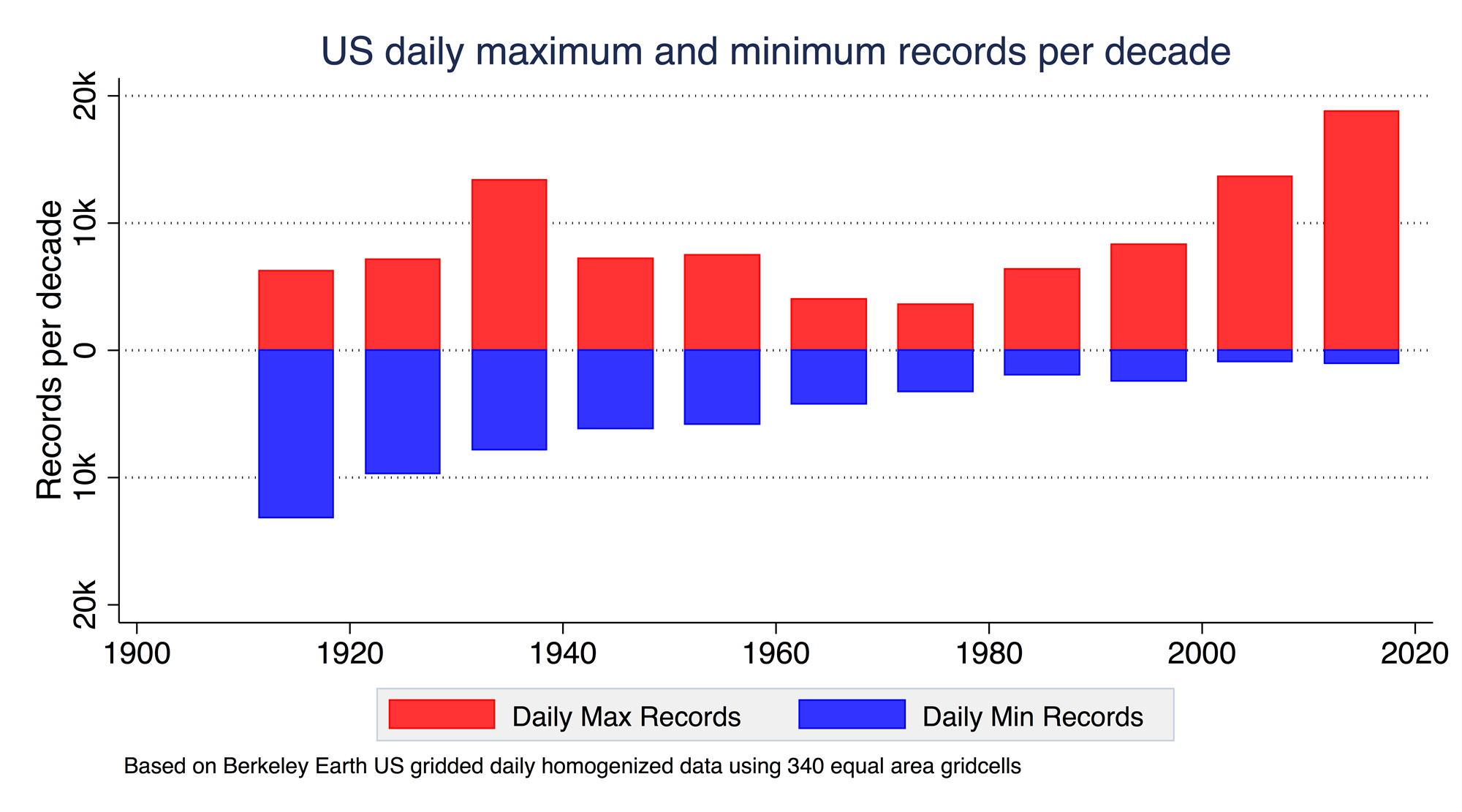
Figure 1: Changes in the occurrence of record-setting daily maximum (TMax) and minimum (TMin) temperatures per decade in the US based on Berkeley Earth US gridded daily homogenized data using 340 equal area gridcells. (Hausfather et al. 2021, AGU Fall meeting)
To examine this further, the ratios of record highs versus record lows were calculated for each year. During the 1960s, there were more record lows than highs. However, when the global warming period began in the 1970s, the ratio of highs to lows began to increase. Over the last decade in their dataset, daily record high temperatures occurred many times more often than record lows.
Looking ahead, Fischer et al. (2021) found that record-shattering extreme heat events were likely to be encountered more often in the coming decades. They note, however, that such drastic record-breakers would be “nearly impossible” in the absence of global warming. In an interview with Carbon Brief, the lead author stated that extremes in a changing climate are like an athlete on steroids – who suddenly breaks previous records in a step-change manner. The following year saw a UK heatwave that did precisely that, with temperature records going down like ninepins and the first 40C daytime maximum recorded from there.
So, while we can still expect cold days and even record cold days, in a warming world there's a much greater chance of daily record highs instead of lows. This tendency towards hotter days is expected to increase as global warming continues through the 21st Century.
Cartoon summary
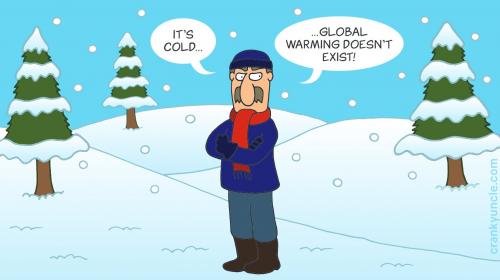
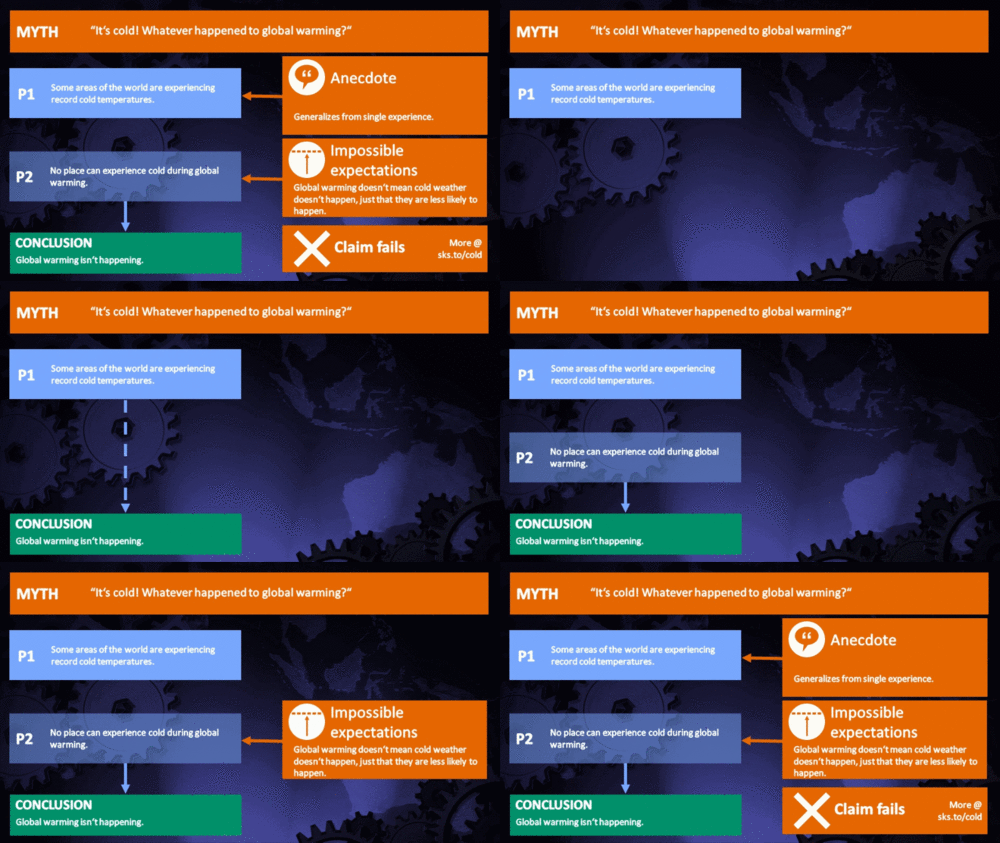
This Cranky Uncle cartoon depicts the "Anecdote" fallacy for which the climate myth "It’s cold!" is a prime example. It uses personal experience or isolated examples instead of sound arguments or compelling evidence. It pairs up nicely with the "It's dark ... the sun doesn't exist" cartoon using the same fallacious reasoning. Please see the accompanying blog post for more information about the cartoon collection.
Last updated on 3 September 2023 by John Mason. View Archives
 Any understanding of that system requires two things:
1 - we must look at the long term trends, not the daily (or even annual) variation and
2 - we must base our understanding on the work of the scientists who are the experts in these things, not on the vaporings of those who cherry-pick data or see everything through their pre-conceived notions.
Any understanding of that system requires two things:
1 - we must look at the long term trends, not the daily (or even annual) variation and
2 - we must base our understanding on the work of the scientists who are the experts in these things, not on the vaporings of those who cherry-pick data or see everything through their pre-conceived notions.







Climate Myth...