



 Arguments









What climate change is happening to other planets in the solar system?
What the science says...
| Select a level... |
 Basic
Basic
|
 Intermediate
| |||
|
Mars and Jupiter are not warming, and anyway the sun has recently been cooling slightly. |
|||||
Climate Myth...
Other planets are warming
"[E]vidence that CO2 is not the principle driver of warming on this planet is provided by the simultaneous warming of other planets and moons in our solar system, despite the fact that they obviously have no anthropogenic emissions of greenhouse gases.
Mars, Triton, Pluto and Jupiter all show global warming, pointing to the Sun as the dominating influence in determining climate throughout the solar system." (Ian McClintock - PDF, page 8)
At a glance
Experienced students of climate science denial will be familiar with many of the arguments that contrarians use. But every now and then you come across a document so crammed with such talking points that they're like raisins in a Christmas pudding. So it is with the 8-page offering containing the above quote, dating from June 2009.
But 2009 is a long time ago now. So much so that one of the big statements in that document:
"With the Sun now entering a ‘quiet’ phase, it is anticipated that this cooling trend is likely to continue until Sun activity increases."
is self-evidently a complete fail, given that according to NOAA, all of the ten warmest years in a data record stretching back to the late 19th century have been since 2010.
That the document is a complete fail, as evidenced by the above quote, is one thing. But how about the claim that the other planets are warming? This is a weird one, given the impossible expectations demanded of those tasked with recording temperatures here on Earth. Accusations of badly-sited weather stations, data manipulation and similar conspiracy-theories abound out there in various dimly-lit corners of cyberspace. But then you get a document from the same stable that claims Pluto is warming up. What's that based on?
Pluto takes 248 years to complete a single orbit around the Sun. Since the body was discovered in 1930, a simple calculation shows we've had the chance to point our telescopes at it for 37.5% of a Plutonian year, so if the place had four seasons then we've not yet seen half of them.
Apart from remote observations made in 1988 and 2002, we did send the New Horizons NASA spacecraft out there in 2006, to make a flyby of the dwarf planet in 2015. It collected lots of useful data in the process, but three sets of observations over 27 years means just what?
Twenty-seven years is just one ninth of a single year on Pluto. On Earth that would be 40 days. What could you say about the climate from that? Wild and unsubstantiated claims, based on very little data, might fool some people but the advantage these days is that they can be fact-checked and quickly. Nonsensical statements thereby reveal themselves to be just that.
Finally, in the 2009 document, all talking-points converge on a single hypothesis - that the Sun is responsible for the current global warming. Only one problem with that, but it's a huge one. Solar energy output is expressed as 'total Solar irradiance' (TSI) and is easily measured by satellites. Since 1980, TSI and global temperatures have diverged. TSI has decreased by a measurable amount, while the global temperature has continued on its erratic but upwards pathway.
It's not the Sun - it's our cranking out of greenhouse gases in their tens of billions of tonnes every year, on and on and on.
Please use this form to provide feedback about this new "At a glance" section. Read a more technical version below or dig deeper via the tabs above!
Further details
This argument is part of a greater one that other planets are warming. If this is happening throughout the solar system, so the argument goes, it must be the sun causing the rise in temperatures – including here on Earth.
This easily dismissed hypothesis depends so much on sparse information – what we know about the climates on other planets and their history – mostly gleaned in the past few decades. Yet its proponents resolutely ignore the most compelling evidence against the notion, specifically that over the last fifty years the sun’s output has decreased slightly: it is radiating less heat. We can measure that heat energy coming from the Sun with good accuracy, both from Earth or from orbit above it. The discrepancy between the facts and the sceptical argument that the sun is causing the rise in temperatures is therefore rather hard to ignore (fig. 1).
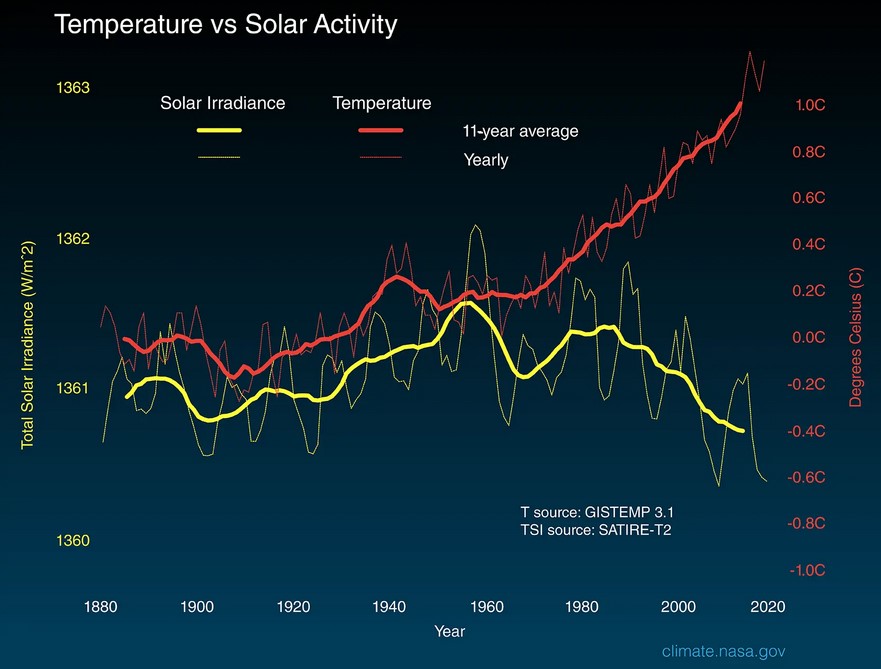
Fig 1: Another 'divergence problem'! Global temperatures plotted against total Solar irradiance, 1880-2020. Graphic: NASA-JPL/Caltech.
But if the sun’s output has diminished a bit, then what is causing other planets to warm up? Or perhaps the better question is: are they warming at all?
The planets and moons that are claimed to be warming constitute eight out of dozens of large bodies in the solar system. Some, like Uranus, may be cooling. All the outer planets have vastly longer orbital periods than Earth, so any climate change on them may be seasonal. Saturn and its moons take 30 Earth years to orbit the Sun, so three decades of observations equates to only 1 Saturnian year. Uranus has an 84-year orbit and 98° axial tilt, so its seasons are extreme. Neptune has not yet completed a single orbit since its discovery in 1846 and neither has Pluto.
This is a round-up of the planets said by sceptics to be experiencing climate change:
- Mars: the notion that Mars is warming came from an unfortunate conflation of weather and climate. Based on two pictures taken 22 years apart, assumptions were made that have not proved to be reliable. There is currently no evidence to support claims that Mars is warming at all. We have covered Mars in more detail here at Skeptical Science.
- Jupiter: the notion that Jupiter is warming is actually based on predictions, since no warming has actually been observed. Climate models predict temperature increases along the equator and cooling at the poles. It is believed these changes will be catalysed by storms that merge into one super-storm, inhibiting the planet’s ability to mix heat. Sceptical arguments have ignored the fact this is not a phenomenon we have observed, and that the modelled forcing is storm and dust movements, not changes in solar radiation.
- Neptune: observations of changes in luminosity on the surface of both Neptune and its largest moon, Triton, have been taken to indicate warming caused by increased solar activity. In fact, the brightening is due to the planet’s seasons changing, but very slowly. Summer is coming to Neptune’s southern hemisphere, bringing more sunlight, as it does every 164 years.
- Pluto: the seasons on this dwarf planet are the least understood of all: its existence has only been known for a third of its 248-year orbit, and it has only been visited by a space probe once, in the 2015 New Horizons flyby. The ‘evidence’ for climate change that this myth is based upon, however, is older: it consists of just two observations made in 1988 and 2002. That’s equivalent to observing the Earth’s weather for just three weeks out of the year. Various speculative hypotheses suggest its highly elliptical orbit may play a part in Pluto's climate, as could the large angle of its rotational axis. One thing we do know now is that sunlight at Pluto is 900 times weaker than it is at the Earth. It's a very cold place indeed.
Claims that solar system bodies are heating up due to increased solar activity are clearly wrong. The sun’s output has declined in recent decades. Only Pluto and Neptune are exhibiting increased brightness, the cause of which remains to be understood, given that we've yet to see a single orbital year with either body. Heating attributed to other Solar System bodies remains undemonstrated. It's the stuff of fantasy.
For lots of useful information about Pluto and the other dwarf planets, NASA has a useful resource on its website. There are also informative pages about the gas-giants Jupiter, Saturn, Uranus and Neptune. For specific details about Pluto, see NASA's Pluto: Facts.
Last updated on 28 January 2024 by John Mason. View Archives







This defense of position is particularly poor and can be refuted by a simple 5th grade-level experiment. Take a brisket and put it in your oven, setting the oven at 175 degrees Fahrenheit. After an hour check the brisket's temperature. Put it back in the oven and raise the oven's temperature to 350 degrees Fahrenheit for twenty minutes. After twenty minutes, take it out and check the brisket's temperature. It went up right? Now put the brisket back on the oven and lower the oven's temperature slightly to 325 degrees Fahrenhiet for a half hour. Take the brisket out and check it's temperature. The temperature of the brisket will have continued to rise! "How is that?", you seem to say, "How could the temperature of the brisket continue to rise when the temperature of the oven went down by 25 degrees?" Your "defense" is that the oven couldn't be warming the brisket because the brisket didn't cool when the oven's temperature was slightly lowered -- even though the oven's temperature was still well above the brisket's point of stasis. Seriously???
mkuske, the only way your analogy is valid is if the brisket has not yet reached the oven's temperature of 325 when you lower the oven's temperature from 350 to 325. The oven is still warmer than the brisket, so of course the brisket continues to warm toward that temperature of 325. If instead the brisket has reached the equilibrium temperature of 350 before you lower the oven's temperature to 325, then the brisket will start to cool down from 350. (And it will cool slower than the oven does, because the brisket has greater thermal mass than the oven's air.)
But let's skip your analogy and use the real Earth. You are implying there is a lag between the increased incoming energy from the Sun and the Earth's heating. You are quite correct. Assuming the Earth initially was in thermal equilibrium (same energy coming in as going out to space), an increase in the energy coming in from the Sun will cause energy immediately to start accumulating in the Earth (by which I mean the atmosphere, surface land, surface water, deep oceans--the whole shebang). But that extra energy is distributed among all the components of "the Earth," which takes time. So although parts of the Earth immediately start heating, there is a lag before the entire Earth system reaches a new temperature. If the Sun's input stops increasing--flattens out--then the Earth's energy indeed will continue to increase, but only until it reaches equilibrium.
But simultaneously, as the Earth's temperature increases, the Earth emits more energy to space. So as soon as the Sun's input to the Earth flattens, the energy imbalance in the Earth (energy in minus energy out) instantly starts decreasing. That makes the rate of temperature increase slow down. But that is not what has been happening. Instead the energy imbalance has continued to increase, and the rate of temperature increase has not slowed. Also, we have a large amount of empirical evidence of the length of the lag between a change in the Sun's input to the Earth and the resulting temperature change (e.g., the Sun's 11-year cycle and volcanic eruptions of large amounts of reflective aerosols). The lag is not nearly as long as the time in which the Sun's radiance has been flat.
For more details, and for a more proper place to put your comments on this topic, see the post "Climate time lag."
mkuske, also see the post "It's the Sun." Be sure to read the Basic tabbed pane, then the Intermediate one, then the Advanced one.
Tom Dayton, First I'll acknowledge that this is a simplistic analogy. However, you're assuming that the Earth has in fact reached the equilibrial state for the amount of increased activity from the Solar Grand Maximum (Modern Maximum), likewise assuming that the equiibrial state would be met almost instantly (in the larger picture of time).
Just like the temperature of the brisket doesn't instantly jump to 350 degrees just because the oven around it did, neither does the Earth when irradiated by the Sun. In fact the oven could heat to 350 degrees in minutes but it would take hours for the brisket to reach that temperature.
In this analogy the brisket only increases in temperature if affected relatively constantly by the heat input of the oven over an extended period of time. Also when the brisket is cooked, it doesn't immediately express it's stored heat and become room temperature, it releases it over time. After all you don't have to heat it back up 5 minutes after it comes out of the oven. Likewise if it's been out of the oven for 30 minutes and you do want it a little warmer, you don't have to cook it for an hour again, starting from scratch. It has stored some of that heat radiation and gets to temperature much more quickly. Likewise the Earth would not immediately express its stored energy especially considering it -- until very, very recently -- has been exposed to a fairly constant and atypical excess of irradiation from the Sun.You're assuming that the Earth -- and rest of the solar system -- has reached the temperature that it would if the Solar Grand Maximum were the typical constant state.
In this analogy, what is typical for the brisket is the 175 degrees worth of heat radiation from the oven. What's typical for the Earth is a normal non-Solar Grand Maximum fluctuation of radiation from the Sun. The brisket only heats because it is exposed to a constant yet atypical 350 degrees of heat radiation from the oven before the oven drops slightly to 325 degrees, as the Earth has been exposed to an atypical and constant amount of the Sun's increased energy, even though there has been the slightest dip in activity -- which is still being atypical.
And the constancy is important. After all if you turn the stove on for 15 minutes, then turn the stove off for fifteen minutes, then turn the stove on for fifteen minutes, then turn it off for fifteen minutes and continue on that way, you won't get very far at cooking your meat as the brisket will barely have time to absorb more enegy than it expresses. Keep that oven on for 45 minutes though, with the meat continuing to absorb more and more heat and what happens? Your brisket gets cooked. As for Earth -- and the rest of the solar system -- because of the extended Solar Grand Maximum, the Earth has been in the "oven" and constantly asborbing a hightened level of radiation for an extended period of time (since approximately 1900). That doesn't mean it met its equilirial temperature for that heightened state of solar activity.
Tom Dayton, I also find it interesting and somewhat amusing the differing standards that are applied. For instance, the reason given for solar activity not causing global warming is that solar activity has retreated ever so slightly (while still being at an atypically much higher rate over an extended period of time). Meanwhile the Earth's temperature virtually flat-lining over a period of time in which CO2 has been released into the atmosphere at the highest rate ever is in fact accepted.
[DB] This thread is about other planets' warming, or not. If you wish to discuss whether global warming has continued over the recent decade+ period, go to this thread where they explain why you are very, very wrong:
Global warming since 1997 more than twice as fast as previously estimated, new study shows
Further, you should also review this post:
Global warming is being caused by humans, not the sun, and is highly sensitive to CO2, new research shows