





Muller Misinformation #4: Time to Act
Posted on 20 April 2011 by dana1981
In a recent interview with National Public Radio (NPR), Dr. Richard Muller made the following statement, simlar to a statement he made in the recent U.S. Conressional hearing (emphasis added):
"An issue, though, that isn't really settled yet is how much of that is due to humans? And that's a subject that really can use more investigation...The global warming attributed by the IPCC, the big U.N. Council that makes this consensus report, attributes about half a degree, half a degree Celsius of warming to humans. But is it .4? Is it .3? If so, we have a lot more time. Is it .6 or .7? If so, we're in a big rush."
Estimating Anthropogenic Warming
Let's examine Muller's more optimistic scenario here. Under what conditions might human effects only be responsible for 0.3 to 0.4°C of the 0.8°C increase in average global surface temperature over the past century?
The impact of a certain effect on the global temperature depends on the radiative forcing (energy imbalance) it exerts on the climate, and the climate sensitivity (λ), which describes how much the temperature will change in response to a radiative forcing when accounting for feedbacks (i.e. changing levels of atmospheric water vapor or ice on the planet's surface).
Radiative Forcings
The IPCC Fourth Assessment Report provides us with a good summary of the various radiative forcings and their associated uncertainties:
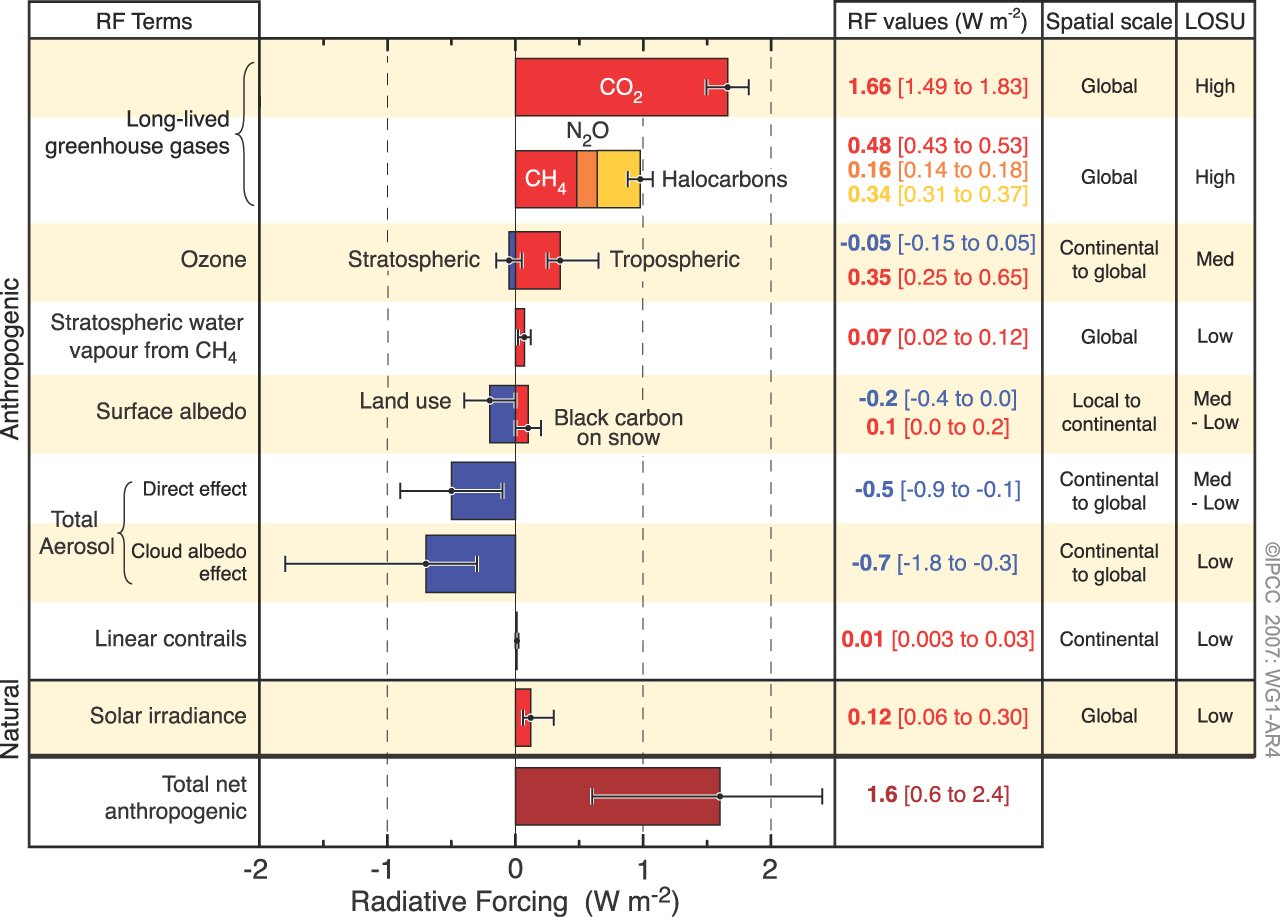
Figure 1: Global average radiative forcing in 2005 (best estimates and 5 to 95% uncertainty ranges) with respect to 1750 (IPCC AR4).
The main radiative forcings are CO2 (1.49 to 1.83 Watts per square meter [W/m2]), other greenhouse gases (1.13 to 1.78 W/m2), and aerosols (-2.7 to -0.4 W/m2). Compared to these man-made forcings, the natural forcings over this same period are relatively very small. Of the 0.8°C surface warming over the past century, Muller suggests humans could be responsible for as little as 0.3°C. Considering the large size of the anthropogenic forcings, this supposition has two requirements to be true:
-
Climate sensitivity must be low so that the large man-made forcings have little effect on temperature, and/or
-
The aerosol forcing must be on the large (negative) side of the possible range of values, thus offsetting most of the greenhouse gas warming, and there must also be an unknown natural effect(s) causing even more warming than greenhouse gases.
Natural Warming Effects
Scientific observations and research have ruled out the main natural suspects (i.e. the sun and volcanoes) as significant contributors to the global warming over the past century, and especially over the past 50 years. Even though we are in a relatively high period of solar activity, the solar forcing is still 10 times smaller than the CO2 forcing alone. This is key – if humans didn't cause most of the warming over this period, there must be a 'natural' culprit.
Many "skepics" have rallied behind internal variability as their alternative hypothesis. However, as we recently discussed, studies have consistently shown that internal variability in general cannot account for more than 0.3°C warming over periods of several decades, and significantly less than that over the past 50 to 100 years. Moreover, natural variability cannot explain many of the observed 'fingerprints' of man-made warming.
The lack of a plausible alternative explanation for the warming over this period is a major flaw in the hypothesis that humans aren't driving global warming. It requires that:
-
The large energy imbalance from increasing greenhouse gases for some reason isn't causing much warming;
-
Some unknown natural effect we can't identify is somehow creating a larger energy imbalance than greenhouse gases; and
-
That unknown, unmeasured natural effect is warming the planet in exactly the same way as greenhouse gases would warm it.
Hypothetically, it's possible that this scenario is reality, but much less likely than Dr. Muller implies.
Climate Sensitivity
As mentioned above, the other variable relevant to determining the cause of a temperature change is the climate sensitivity parameter. Although there is a significant amount of uncertainty in this value, a broad range of estimates using many different lines of evidence can be combined to give us a plausible range. It can take several decades for the climate to fully respond to a large radiative forcing because most of the energy imbalance goes into the oceans, and water takes a long time to heat up. Thus in order to estimate how much the surface temperatures should have warmed so far given the current radiative forcings, we need to use the transient climate sensitivity, which the IPCC puts between 1 and 3°C for a doubling of CO2. This corresponds to a transient climate sensitivity parameter of 0.27 to 0.81 Watts per square meter per Kelvin.
Keep in mind that temperatures will continue to rise above the transient temperature until the planet reaches equilibrium. The transient temperature change represents approximately two-thirds of the eventual equilibrium temperature change.
Temperature Attribution
We now simply need to multiply the radiative forcings by the transient climate sensitivity parameter to evaluate how much warming they should have caused thus far.
| Effect |
Forcing (W/m2) |
Temp Change (°C) |
| CO2 | 1.49 to 1.83 | 0.40 to 1.48 |
| Other GHGs | 1.13 to 1.78 | 0.31 to 1.44 |
| Aerosols | -0.4 to -2.7 |
-0.11 to -2.19 |
If we look at just the warming effects, CO2 alone has caused at least 0.4°C warming already, and anthropogenic greenhouse gases at least 0.7°C. This is significantly larger than the minimum number (0.3°C) sugested by Muller as the potential human contribution to the global warming over the past century.
However, when we factor in the highly uncertain aerosol effects, the numbers become more muddled. It's possible that the cooling effects from human aerosol emissions could have offset most of the warming effects from human greenhouse gas emissions. But in this case we still run into the problem described above: if human effects aren't driving global warming, then what is, and why is it behaving exactly like human-caused warming would?
Muller's Optimistic Scenario
At the very least, human greenhouse gas emissions have generated 0.7°C warming of surface temperatures so far. Thus Muller's optimistic scenario in which humans have only caused 0.3 to 0.4°C warming implies a substantial cooling effect from human aerosol emissions. So in this optimistic scenario, is Muller right that "we have a lot more time" to reduce greenhouse gas emissions?
Unfortunately not. There are three important points to keep in mind:
1) Aerosols have a very short lifetime in the atmosphere, unlike CO2, much of which will stay in the atmosphere for centuries (Solomon et al. 2009), and globally there is significant effort to reduce aerosol emissions. Thus these aerosols only act to temporarily mask the greenhouse gas warming.
2) If Muller's optimistic scenario is correct and the aerosol forcing is offsetting most of the greenhouse gas warming, that also means there must be some other forcing as large or larger than the greenhouse forcing, causing most of the observed warming. However, observational data has ruled out the likely culprits such as the sun and volcanoes and internal variability. It is a very slim possibility, and not one we should bet our future on.
3) Approximately 33% of the equilibrium surface warming from the greenhouse gas emissions so far is still unrealized, but inevitable. Remember that at a minimum they've generated 0.7°C warming so far, which means that in the absolute best case scenario we're committed to at least 1°C warming, with 2°C considered the 'danger limit', and greenhouse gas emissions continuing to accelerate.
Even in Muller's unlikely optimistic scenario, we still don't have "a lot more time" to get our greenhouse gas emissions under control.
Running out of Time
Ultimately with what we know and the observational data we've obtained, we can say, as the IPCC did, that it's very likely (greater than 90% confidence) that most of the observed increase in global surface temperatures since the mid-20th century is due to human greenhouse gas emissions. We can also say that at best (or perhaps worst), aerosols are temporarily offsetting a significant amount of the well-known greenhouse gas warming, but that this is not a permanent solution, and that the greenhouse gas warming will only continue as emissions continue to rise and the planet continues toward equilibrium.
Even if the best case scenario is true, it does not mean "we have a lot more time," as Muller claims. For example, IPCC emissions Scenario A1T (approximately 580 ppm CO2 in 2100; Figure 2) assumes continued rapid economic growth, but a rapid transition in energy production away from fossil fuels such that global human CO2 emissions peak in 2040. Keeping greenhouse gases at these levels requires transitioning away from fossil fuels starting immediately.
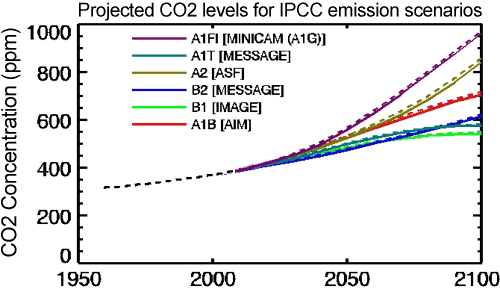
Figure 2: Atmospheric CO2 concentrations as observed at Mauna Loa from 1958 to 2008 (black dashed line) and projected under six IPCC emission scenarios (solid colored lines). (IPCC Data Distribution Centre)
The IPCC also projects that other greenhouse gas emissions will continue to increase, whereas aerosol emissions will decrease. Thus even in this scenario where we take major steps to reduce emissions immediately such that they peak in 2040, even if climate sensitivity is toward the low end of possible values (~1.5°C for a doubling of CO2), by 2100 we will have committed ourselves to 2°C warming above pre-industrial levels (the danger limit).
The key that Muller is missing is the extreme degree of our reliance on fossil fuels and the magnitude of the effort required to change that. If we could just flip a switch and turn off greenhouse gas emissions, we would have a lot more time. Unfortunately, reality is not so simple.
More important than the warming we have caused so far is the warming we are committing ourselves to in the future, which is already approaching dangerous levels, and may be on the verge of surpassing them (Arora et al. 2011). Our time is quickly running out even in the most optimistic scenarios, and it is very important not to fool ourselves into thinking otherwise.
Although this particular statement by Muller was not a major error, particularly in comparison to some of his other recent statements (see Muller Misinformation #1, #2, and #3), it pertained to arguably a much more important subject. Many of our policymakers are looking for any excuse not to take action to slow climate change, and making careless statements which can provide them with those excuses is a mistake.

Arguments


To my mind the critcicism boils down to a serious logical inconsistency in his argument...he has great confidence in the impact of some countering natural force we have not detected and do not understand, and at the same time a lack of confidence in climate sensitivity to CO2 that is physically well understood and that scientists have taken great pains to measure forward, backward and sideways for the better part of 40 years. It's hard to understand how a scientist can honestly take that position.
There also seems to be the same implicit contradiction we see so often regarding low climate sensitivity to human influences and high sensitivity to natural influences. Basically, have your cake and eat it too.
Both seem to me be betray wishful thinking at best.
I do not care what causes global warming; I want action now. Let's get the patient to the hospital. We can assertain who is responsible for causing the injuries later.
One sees a lot of those same excuses (especially recently) trotted out by the same so-called skeptics who post most regularly on here. However, can any of them be called "careless statements" ? I'm not so sure, especially from the ones who continually post the same self-regarding, snide, self-important, repetitive beliefs about themselves, their abilities and their 'arguments'. And most especially from those who cherry-pick data, trim graphs and assert what cannot be deduced from any sources they actually give - well, those who can produce any sources that can back them up in any way.
Ultimately, it is good that you are rebutting those who are more in the public eye and who have their opinions more widely broadcast. But it has to be asked whether (as Alec Cowan has suggested elsewhere) it is worth the disruption constantly answering the same simplistic assertions from the same people on this site, just so you can say that anything can be posted unless it goes against certain minimum standards. Surely those who have to constantly reply, to make sure that the denial/disinformation/propaganda is not left unanswered, could use their time more productively on posts like this ?
Anyway, sorry for going on (and please delete if it is too far off-topic), but I feel this needs to be discussed somewhere - before people are driven away by having to read the same people repeating the same hand-waves time after time after time.
Hope for the best. Plan for the worst.
JMurphy #4 - my feeling is that if someone continues making the same simplistic assertions, the best response may be to just ignore them. If they become too trollish, they may be banned from the site. But I don't want to get off topic discussing moderation and general commenting.
Perhaps we can do better. It is noteworthy that solar natural forcings rose more sharply in the early half of the century, while anthropogenic forcings rose more sharply in the second half. Suppose then that the full effect of natural forcings have been felt, but only half the effect of anthropogenic forcings have been felt due to thermal lag. Well then the effect on the current temperature increase would be 50-50, and both natural and anthropogenic forcings would be responsible for 0.4 degrees C of the current increase, though once equilibrium is reached, anthropogenic forcings would be responsible for twice the temperature increase of natural forcings. But in this scenario, each 1 Watt of forcing is responsible for 1.33 degrees of temperature increase. That compares to the IPCC standard of each Watt of forcing resulting in 0.8 degrees temperature increase. In the long term, that is hardly reason for complacency.
And of course, this assumes the 1 in 400 chance of the most favourable outcome. There is an equal probability that natural forcings are only responsible for 0.06/2.4 or 2.5% of the 0.8 degrees warming. Overwhelmingly more probably, the ration is 0.12/1.6 or 7.5%, in which case anthropogenic forcings are responsible for 0.75 degrees of the warming todate (or 0.68 if the natural forcings have fully worked into the system) (This paragraph essentially recaps Dana's paragraph about temperature attribution).
I know this analysis is rough and ready, but it shows prima facie that Muller's implicit probability function is wildly optimistic; and that he seriously underestimates the IPCC attribution of temperature increase over the 20th century.
"How much is due to varying solar activity and how much due to humans is a scientific issue that we're trying to address."
When he knows (or should know) full well that that issue has been done to death already. It feels like a bait and switch...
And that quote is not the only example. He touches repeatedly on the uncertainty of the human contribution and the exagerrations of those contributions relative to natural forcing, as if those topics have not been an intense subject of research for the last 20 years. As Tom Curtis points out, it's really hard given all that research to see how he can deemphasize the human impact as much as he does without a predisposed bias to do so.
And he has to know what the effects of his ambivalence, given the PR echo chamber that's in place out there. Every scientist I know is aware of the distortions it produces...acutely so.
I'm still waiting for some signs that Muller will be balanced.
We'll have to wait and see I guess.
which "observations" have ruled out internal variability ?
How can such a major thing be continually ignored? I am not the only person who has made this accusation against those who are certain of global warming.
As an engineer who was not allowed to make ANY assumptions when I did my experiments in Chemistry and Physics classes while in college, I find the lack of real scientific approach to be alarming.
"The key that Muller is missing is the extreme degree of our reliance on fossil fuels and the magnitude of the effort required to change that."
Well, when I argued that it may be not only very difficult, but impossible , to give up fossil fuels without a big decrease of our standard of living (which would anyway occur if this is true), I got a lot of comments insuring me that FF weren't at all necessary, that alternatives existed already, that it was even cheaper ... so how can it be simultaneously easy, and very difficult, that we're extremely reliant on them, although cheap alternatives exist, and that the success is granted although it requires an enormous effort .... may be there is a logics inside but I'm currently unable to see it.
That is very surprising. How about thinking about it this way : 'Cigarettes are easy to give up - just put them away; but it is very difficult to do so - due to addiction. A cheap alternative exists - don't smoke or get some alternatives sources of nicotine through the NHS. Success is granted (healthy and longer life) but it requires an enormous effort, due to the addiction and reliance on them.
That sounds quite logical (in the way that you have expressed it, mind), but can you see it ?
By the way, the word you were looking for was 'assuring', not 'insuring'. Perhaps that was confusing you, if you were trying to be logical using the definition for 'insuring' ?
Concerning FF, most part of the alternatives do only produce electricity, but there is no addiction to the way electricity is produced ! people just plug their devices , you know, and they don't care at all how electricity is produced - anyway in a lot of countries, it is already produced without or with very few FF and it's exactly the same. And for non electricity uses, well - convenient alternatives do simply not exist. It's a nonsense to claim both that it will require a great effort and that we are sure to be able to live without them.
Sorry for the confusion insuring/assuring - that's the same word in French (assurer).
and which observation rules out long term unforced variability ?
Gilles wrote : "18 : No it's not logical - If it is not easy to stop smoking, it's difficult, and success is not granted."The last off-topic comment from me - can't guarantee that this will be the case for others, of course !
It is very logical. You want to stop : you stop. I did so five years ago, after 20 years as a smoker. It was the logical thing to do, I did it. End of story.
Simples.
Winters warming faster than summers, nights warming faster than days, poles warming faster than tropics, troposphere warming while the stratosphere cools, increase in downward long wavelength radiation from the night sky, decrease in long wavelength radiation leaving the top of the atmosphere. All of these are exactly analogous to the effect you would see if you were to increase the insulation on a house in a cool climate without adjusting the heating.
Thus all of these indicate that the recent warming is due to an increase in the heat trapped below the stratosphere - which we call the greenhouse effect.
My test of objectivity rests on the point that Tom made...if anyone is going to talk about uncertainty regarding the effect of humans on climate change, they have to acknowledge uncertainty at both high and low ends. To the extent that Muller emphasizes the low end and the tendency for human impacts to be exagerrated rather than underestimated, he fails to be objective. He is buying into a narrative about the intentions of scientists (they never talk about uncertainty, they are advocates etc) a priori based on hearsay rather than taking a neutral position and focusing on the data and the reported research. That's just not very skeptical, IMO.
No - usually what's difficult is not sure to be overcome, only. So you must also take into account this possibility.
This is based on data presented in:
Combinations of Natural and Anthropogenic Forcings in Twentieth-Century Climate - Meehl et al
http://www.cawcr.gov.au/bmrc/clfor/cfstaff/jma/meehl_additivity.pdf
Which is why the availability of reasonable alternatives we can work toward is relevant...it makes the difficult possible. You see?
By emphasizing only one side of uncertainty envelope regarding human effects on climate and engaging in yet another evaluation of climate science, Muller is effectively delaying a change that will take time to implement.
He is worried about attribution past climate change to humans. However he should also be worried, were he objective, about the risks associated with delays in action should he find the human contribution is dominant, as is very likely.
I'm continually surprised by the notion that acting is going to cause terrible harm to the world economy. There is very little to support that argument. On the contrary there is every reason to believe it will improve the economy much in the way that WW2 laid the groundwork for the prosperity that followed the war. AND, a war is a destructive act with many years of clean up that follows. Addressing climate change would be a constructive act, no clean up required.
Because of the tendency to call anyone who disagrees a troll, this blog risks becoming place where like minded people come to be massaged. This is not healthy. From my own point of view, I have derived great benefit from having the errors of the so-called trolls exposed by the more knowledgable posters here.
The irony is that most topics here are about refuting just such false information by prominent climate sceptics, so it seems strange to ban posters who hold these same false views. Instead you could educate them - and others, like myself, who are just getting a grasp on the complexities of climate change. Otherwise you come off looking like you cannot provide the answers or you have something to hide.
As for off topic comments: Most off-topic comments merely enlarge on a topic rather than detract from it. For learners like myself that is very useful. Moreover, no one has yet come up with an off topic comment that comes anywhere near rivalling that of a certain article written here a few weeks ago which was about as far off topic as you could possibly go for a blog called Skeptical Science.
He seems now to be set upon investigating climate sensitivity and human attribution, which were not part of BEST's original remit. Hell, but his daughter is program manager! He can do what he likes.
I suppose he is not the first to change the goalposts, and hope the funders are ok with it.
"Over the last 40 or so years, natural drivers would have caused cooling, and so the warming there has been … is caused by a combination of human drivers and some degree of internal variability. I would judge the maximum amplitude of the internal variability to be roughly 0.1 deg C over that time period, and so given the warming of ~0.5 deg C, I’d say somewhere between 80 to 120% of the warming. Slightly larger range if you want a large range for the internal stuff."
Does Muller cite any substantive and credible scientific evidence to support the claim that only < 50% of the observed warming may be attributable to elevated GHGs from burning of fossil fuels? If he is just musing then that is not scientific or constructive. And it is certainly not a smart strategy to base policy and action on such a serious matter based on wishful thinking.
Oh, hello Rob @30, fancy running into you here ;)
If so, then we're in an even bigger rush.
You raise some valid points, but I have to take issue with you on one of them:
" Instead you could educate them - and others, like myself, who are just getting a grasp on the complexities of climate change. "
Trolls are simply not open to having their minds changed or learning. That is a fact. And by trolling, and driving posts off topic and obfuscating, it inhibits SKS and the more knowledgeable posters here for educating and informing others. It also creates an unpleasant environment that also deters people from hanging around and/or contributing and learning in the process. To my knowledge only one person has been "banned" from posting here at SkS, and IMHO, that decision was completely justified and probably made for the safety of people posting at SkS.
It is a bit of a conundrum. But there have been quite a few genuine trolls here of late and Gilles is one of them. I must admit though, I have learnt an awful lot chasing down and refuting the misinformation and distortion that 'skeptics' seem so fond of disseminating.
I'm curious to which off-topic SkS article you are referring to. Anyhow, my suggestion would be to voice your concerns directly to John Cook by email-- as you know he is an incredibly nice and reasonable person, and he will value your input.
Moderators feel free to delete, maybe after Bill has acknowledged reading my post?
However, when said skeptic refuses to read the evidence they are pointed to, repeats errors that have already been pointed out with no more than an "I don't think so", and even contradicts themselves to keep the argument going - well, then they are not interested in learning, only arguing.
As to off-topic - every time someone raises an off-topic point, they are directed to where the question/data/argument is relevant. That way discussion of particular issues are concentrated to where interested readers can find them, not scattered about the website. But again, when that poster persists in doing this over and over and over despite requests?
What should the moderators do? I would love to hear a good idea in that regard.
You can lead a horse to the data - but you can't make it read the references...
I believe that represents they suggest the appropriate strategy for dealing with Gilles' trolling.
I am well aware that the skeptics' position is not realistic, but all this 'It is anthropogenic - no it isnt' business only serves to delay the urgent action so obviously needed. As far as I am concerned global warming almost certainly is anthropogenic in origin; either that, or the rise in atmospheric CO2 being in line with the increase in fossil fuel consumption is one big coincidence that also confounds isotopic analysis.
BUT if you look at the debate on this site and also Dr Muller's argument (and of those like him), the need to tie it or untie it to mankind seems to outweigh the much more important consideration of the need for urgent action.
Consider an imaginary situation where we had been producing the current volume of CO2 for centuries, but global temperatures had only recently begun to rise. In those circumstances very few would argue with the IPCC when it concluded that the temperature rise was not anthropogenic in origin. There would still be vested interests that would want business as usual, but they would have a much harder time rabble rousing than they do at present. Would we as a species take a 'What will be, will be' approach because it is not anthropogenic in origin, or, knowing what we know about the greenhouse effect, would we cut our production of CO2 in order to counter whatever actually was the cause; that, and a whole lot of planning should the situation deteriorate in line with scientific predictions. I rather think we would take the latter route and p.d.q.
So, let’s forget about who, or what the heck, is causing the current warming, even though we are as near to certain as makes no difference and realise that waiting while we completely resolve the origin is a luxury we cannot afford. Surely no one intellectually above that of the lesser spotted wood lice is going to believe that the current warming is going to reverse when there are no cycles that fit the observed long-term trend. (And yes, I am aware of Lord Lawson’s point of view, but I have the advantage of living in a country at time when he was in government and his policies as Chancellor of the Exchequer all went pear shaped. (Yes, history does repeat itself.))
We should challenge the sceptics refusal to act and if they argue that reversal is imminent, we should demand robust scientific evidence in support. Heaven knows there is enough robust scientific evidence on this side of the fence.
This sentence in particular grabbed me, "If we could just flip a switch and turn off greenhouse gas emissions, we would have a lot more time."
If I may restate the obvious: Following the work of Hansen, Tripati, Arora, and others, we are already on thin ice with the warming yet to come. It may not be practical to replace FF use entirely for decades. During this time more warming backlog will be created. The lag inherent in the system creates a terrifying delay between our actions and their consequences.
It's terrifying because there just are not enough long-term thinkers in the world.
Hmm, I wonder if there is a correlation between cultures with a higher propensity to consume (indicative of short-term thinking) and cultures with a reluctance to take corrective action on climate change.
The uncertainty argument gets flipped on it's head, and in this instance especially. It is our uncertainty surrounding sensitivity and aerosols and UHI (which, I believe he is looking at differently than others) that make the statement about 'having time' so wrongheaded. His study is merely another thermometer, has no attribution modelling, AFAIK, and doesn't really speak to how each degree of temperature rise changes the planet, or each W/m2 of forcing changes the energy that drives the atmospheric systems or how heat effects the hydrological cycle, etc. Those are the realities that we will be dealing with, not numbers on a stick. Our policy time table will be set by real-life effects because policy is about real people, what we value, and how willing we are to put what we value at risk.
If humans are causing the warming by emissions of greenhouse gases, then the obvious & most urgent action is to reduce or eliminate GHG emissions.
If, on the other hand, it were all down to natural causes, then our most immediate priority would be to prepare human civilisation for the coming climate changes.
The best science out there tells us that it's more than 95% likely that it's the former, not the latter, so the prudent course would be to reduce GHG emissions as quickly as possible.
From a risk management point of view, I think the response to the recent events at Fukushima Dai-ichi tell the story.
What's the chances of a magnitude 9 earthquake and a 14 metre tsunami hitting a nuclear power plant in it's operating life? I'd wager those odds are less than 1-in-20, even in Japan, and yet nuclear plants all around the world are scrambling to make sure they're prepared for far more unlikely eventualities.
On the other hand, we've got a higher than 19-in-20 chance of climate disruption with associated human cost and massive economic losses (measured in the tens or even hundreds of trillions), and we have crowds of deniers running around shouting that we don't need to do anything, because there's too much uncertainty.
Just to stray off-topic (mods, feel free to delete this last para!) - I'm starting to get quite amused how Gilles seems to post on every single thread, no matter what the topic, a comment about how we supposedly have no alternative to continuing use of fossil fuels, despite people pointing out such alternatives to him many, many times in the past. I agree entirely with the mod position: do not feed the troll. But I also agree with Tom Curtis' suggestion that trolling comments be deleted and replaced with a link to the appropriate page for that discussion. Otherwise, the trolling has achieved it's objective of diverting the reader's attention from the topic at hand, and that seriously detracts from the much more valuable discussions that appear in the comments here.
http://www.skepticalscience.com/argument.php?a=36#48902
I would greatly appreciate your fixing the hyperlink.
With currently known forcings, a low climate climate sensitivity (req. 1) would imply a small aerosol forcing (the opposite of req. 2) in order to be compatible with the observed warming (as was discussed on this site by Dana and myself recently).
No, the cause of global warming does not matter in the short-term. Simple question: Do greenhouse gases have a warming effect on the atmosphere? Answer: Yes. If by the most remote of chances the current warming were due to some hitherto unknown cause rather than us humans, would reducing greenhouse gas production help reduce the amount of warming taking place? If the answer is yes, and I rather think that it is, then we should reduce greenhouse gas production, period.
Put it another way, if your cellar is filling with water, would you switch on the pumps immediately, or would you wait until after you were sure of the cause?
Much more important is the fact that the politicians will in the main react to public opinion. The public sees both sides arguing about the cause of the warming and thus forms the opinion that the cause is far more important than it really is.
In the long-term it is very important, because it is going to cost a lot and any nation seen to have contributed more than most will be expected to pay more than most. I will bet a pound to a pinch of snuff that that is what really motivates most of those politicians currently arguing about the cause of climate change. Unfortunately, all this 'It is us. No it isn't us.' palaver is stopping a sizeable chunk of the public from demanding action because they think we have to resolve the issue of the cause before we can act. Meanwhile, the politicians wring their hands and demand a clearer mandate.
We should call a truce in the argument about the cause and agree on the need for action. If the sceptics can prove that it is all going to subside, then we can all breath a sigh of relief. I very much doubt that such proof exists, and if it doesn't, then the need for action becomes overwhelmingly obvious. That is the debate the public should be having a grandstand view of, not the tired old 'We are to blame. No we aren't.' one. Small wonder the pubic is switching off. The argument keeps going round in circles. There will be ample time to aportion blame later, when we have a clearer view of the size of the problem and even more proof of the cause (if that is possible).
Perhaps, I've not read enough of Gilles to pick him as an intentional troll. However, I've experienced for myself repeating an argument because I've felt it hasn't been properly addressed and then being called a troll when all I was doing was looking for a response that convinced me that what I was saying was wrong. Sometimes it takes a while for the penny to drop.
Also, I think trying to keep the topics all nice and clean and ordered sounds sort of control freakish. In my opinion, the meanderings and diversions are often as interesting, sometimes even more so, than the on-topic discussion.
And the article I was talking about is that one where the author voiced his religious beliefs. How off-topic was that in a science blog? So let's not get too precious.
-----------------------
KR asks what the moderators should do?
Let the discussion flow where it will. If you think a particluar poster has nothing to offer you are free to start ignoring his posts. Others may think they are worth responding to as an object lesson on how climate sceptics misdirect, misquote, and misunderstand. This is informative for those who are just setting out to understand the issues.
Perhaps I will feel diferently when I have a greater grasp of the issues.
As for allowing discussions to meander, I'd rather discuss issues other than nuclear power, at least occasionally.
It doesn't matter to me whether we are or aren't the cause of the warming we see. If warming were the result of a war between leprechauns and the fairies at the bottom of the garden, reducing CO2 output is the _only_ means we have available of influencing global temperature. And we should do it anyway because the alternatives in terms of energy use and production are more beneficial to our health and our pockets.
(And this _is_ strictly a personal view, it's a move away from crude stone-age or Victorian or otherwise clumsy and primitive burn-any-flammable-stuff-you-can-find approach to heat and power. I have a strong bias towards elegance and simplicity in engineering to support a civilised civilisation.)
What is great about SkS is that I think most all of us come here to learn something. None of us have total knowledge of these issues and we all have the opportunity to learn from each other. I consider my positions on climate change to be very fluid as I learn more. And I think that's true of most people here. Others are here, not to learn, but to defend a position.
That's where people come off as being trolls.





