





Temperatures Continue Up the Escalator
Posted on 8 January 2013 by dana1981
The Escalator has been one of Skeptical Science's most popular features since its inception just over one year ago. Over the past year, it has been used in many climate myth debunkings, mainstream media stories, and most recently was even used by Senator Sheldon Whitehouse on the floor of the US Senate (the full transcript of the Senator's excellent speech can be viewed here).
The Escalator was also featured in the PBS documentary Climate of Doubt. Both of these videos are hosted on the SkS YouTube channel.
And The Escalator was also featured in the rebuttals to the 2012 Golden Horseshoe Award (formerly the BS Award).
Bob Tisdale recently suggested some sort of Escalator-related impropriety because when he attempted to re-create the graphic, the slopes he found for the 'steps' were different than in the SkS version. The reason for this is quite simple, the surface temperature dataset analysis methodologies are periodically revised, and Tisdale was using newer versions than were used in the previous Escalator graphics.
Below is an updated version of The Escalator using the most recent surface temperature datasets as of late December 2012, updated to include the monthly data through November 2012. The timeframes for each 'step' are listed in the figure caption, and each step is the linear trend between those points.
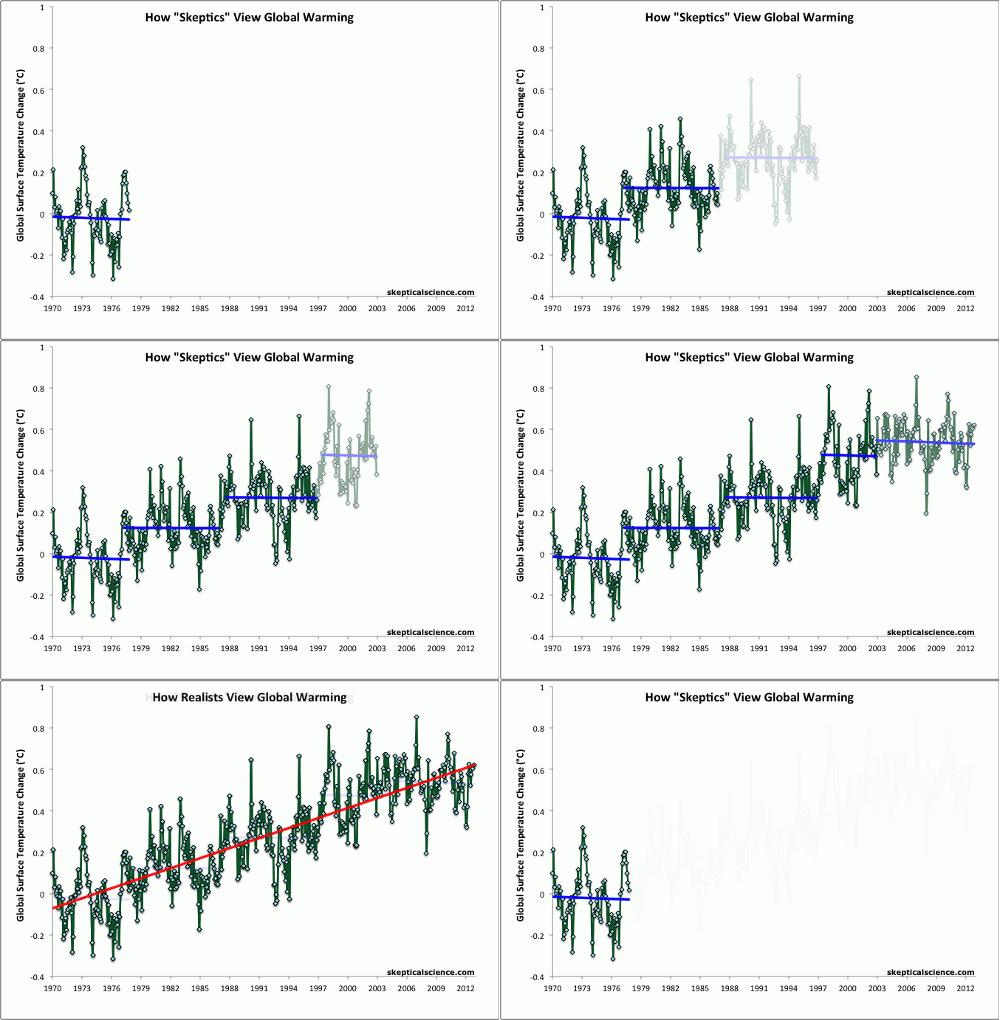
Average of NASA GISS, NOAA NCDC, and HadCRUT4 monthly global surface temperature anomalies from January 1970 through November 2012 (green) with linear trends applied to the timeframes Jan '70 - Oct '77, Apr '77 - Dec '86, Sep '87 - Nov '96, Jun '97 - Dec '02, and Nov '02 - Nov '12.
The global surface temperature trend from January 1970 through November 2012 (the red line) is 0.16°C per decade.
The Escalator page now also has links to images of the first and last frames, as well as the 'steps' and long-term trend combined in a single image.
Our hope is that the popularity of the Escalator will decline as a result of climate contrarians abandoning the absurd myth that global warming has stopped. Then again, John Cook thought that Skeptical Science would be obsolete by now due to global warming denial becoming an untenable belief, so we suspect The Escalator will continue to be a useful myth debunking tool for some time to come, particularly since climate contrarians seem to prefer nitpicking the graphic to learning from it.

Arguments


Data know no religion, they just are what they are. The laws of physics are not Papal Bulls. Science is not faith: in fact, it is the opposite to faith.
Sigh.
This is faith that the high priests of denialism should ponder:
2. It is your established wont to file a 1-off statement at odds with the science and/or the thread on which you place it. And to then not respond to the follow-up comments by others. Perhaps we should just ignore this current comment as the incipient ideological pap it purports to be, no?
Personally, I also quite like showing how the recent temperatures fit well within the expected range of the earlier trend, like Tamino's gif, and I think John Nielsen-Gammon's method is an incredibly powerful way of illustrating why "the last step is the longest step":
... or even just statistically significant evidence that the underlying rate of warming has dropped?
Would it be possible to create an escalator that also took ocean heat content into account? Or could SkS always show the Escalator along with a graph of ocean heat so that we won't have to be subjected to comments along the lines of Klappers?
BUT... That's not the issue. We are not outside the 2-sigma range and therefore we are still within the bounds of what is expected for GHG driven warming.
We know, without any doubt, that surface temps are going to jump at some point to keep pace with the long term trend. Basic physics dictates it. It's just a matter of when the jump occurs.
When that happens, it's game over for denial.
The French newspaper "Le Monde" has an article in the online edition reporting that the BoM had to add a new color to their temp maps because of the abundance of forecast temps above 50 deg Celsius. They mentioned a forecast 54 deg Celsius temp in the center of the country.
http://bigbrowser.blog.lemonde.fr/2013/01/08/hors-limite-il-fait-si-chaud-en-australie-que-la-meteo-a-ajoute-une-nouvelle-couleur-a-ses-cartes/
Can you let us know if that materializes John?
Not cooling too fast down there it seems...
BTW, UAH lower troposphere temps is in record territory and way above 2010, (of course Spencer had to write a v5.5 to lower the warming) so a good chance of 2013 seeing a new record, but I would not be surprised if we saw a triple dip La Nina.
Remember all the noise in the anti-science community last year, when sea level dropped somewhat from 2010 due to all that water being dumped on land (due to the La Nina).
Two years ago they claimed that we would cool drastically in the coming years due to the weak sun cycle, but now, they tell us that the heat is due to the strong solar activity.
Why do they get away with this flip-flopping?
If this got pointed out to the average Joe, the denialist community would suffer a serious blow, but it does not happen, so they keep on flip-flopping.
Maybe CNN will, as they (at least Amanpour)have repeatedly pointed out/corrected visiting (real) scientist that the "other side" are deniers, not skeptics, as the often too polite scientist tend to call them. Hopefully more of the press will follow that exemple. Looks like it is happening, and the deniers don't like it one bit, thus their increasing desperation. They got spoiled when they used to have near total control of the press from late 2009 to early 2012.
“Insanity is doing the same thing, over and over again, but expecting different results.” ― Albert Einstein
Source: http://data.giss.nasa.gov/gistemp/graphs_v3
Regarding your ENSO effect graph, If you believe that 2013 will be ENSO neutral (the black points), the projection would be an anomaly record in the GISS dataset right? Of course there is a lot of variability but that would be the expection I think. We will know soon enough.
On that topic The lastest Met Office long range forecast predicts 2013 will likely not be a record, maybe an anomaly of .35 against the 1971 to 2000 baseline (according to their published graph). If true this forecast will make the last step in the escalator even longer.
Do you have a typo in your post? 1982 to 2002 is nowhere close to being an escalator "step" (showing no warming).
I've done a rolling 15 year linear regression on the HadCRUT4 dataset. The trend ending in 2012 is the slowest warming since the trend ending in 1980. The most recent 15 years is also slower warming than all trends calculated between about 1915 and 1950.
If you are going to make claims, please provide some supporting links.
The Met Office forecast is for a record in 2013.
See Hot Topic NZ for more details.
Two questions:
1) How many of those 15-year regressions were statistically significant?
2) when you tested for statistical significance, did you do it for both an expected value of zero, and an expected value of the long-term warming trend?
Now how about addressing the point of whether any of your analysis provides statistically significant evidence of the modelled trends being inconsistent with the observations, or whether there is statistically significant evidence of a change in the underlying rate of warming.
1979 - 1998: 0.110 ± 0.113 °C/decade (2σ)
1979 - 2012: 0.158 ± 0.048 °C/decade (2σ)
So in the 19 years prior to the point when global warming supposedly stopped, the trend was not statistically significant but had a most likely value of 0.110 °C/decade; after it supposedly stopped, the trend increased to 0.158 °C/decade and became very statistically significant. Hmm...
Of course, the longer trend lies within the uncertainty interval of the shorter trend, so this isn't evidence that it's changed, merely a warning to those who would make the leap from "trend is not statistically significant" to "trend is 0", which is very different.
The jump from "trend is not statistically significant" to the "trend is zero" is indeed invalid. If a trend is statistically significant, it just means that the observed trend would be highly unlikely IF the underlying trend was zero. So if it is insignificant, it just means that it would not be highly unlikely to observe the measured trend IF the underlying trend were actually zero. Note the conditionality, it only allows you to make statements about what you might or might not expect to see IF the underlying rate of warming was zero.
Now you could make the subjective judgement (which is not compatible with the ususal frequentist hypothesis testing framework) that if the measured trend is not highly unlikely if the underlying trend were actually zero is equivalent to saying that the measured trend is evidence that it is possible that the underlying trend is actually zero. However, even then, the lack of a statistically significant trend only means that you can't rule out the possibility that the underlying trend is zero, which is hardly a ringing endorsement of the claim being made by the skeptics.
My point is that the flattening in temperature growth is real. The Met Office prediction to the end of 2017 just recently published shows more sluggish growth.
You make the point that all natural factors are working against warming right now. It is true that the average MEI is negative since 2000 or so which would suppress temperature growth (average about -0.1). It was also more strongly negative from 1950 to 1975 or so (-0.3). However, it was strongly positive from 1975 to 2000 (+0.4). Consider the possibility that if warming is being now suppressed by ENSO, it was being aided by ENSO in the period 1975 to 2000, so that some part of that warming is not due to GHGs.
The problem for the AOCGCM models is that if there is a natural cycle in ENSO, they don't know about it. Therefore they are "tuned" to replicate the warming from 1975 to 2000 via feedbacks as if it is solely due to GHGs. If that is not true they are possibly overpredicting the warming rate going forward.
I think my other point in posting here is to show your community that skeptics are not the simpleton thinkers they are made out to be on this forum. There should be room for alternative interpretations without generating the "fake skeptic/denier" type of name calling.
Even the "mid-century cooling" trend from 1940 to 1970 is not statistically significant: GISTEMP -0.015 ±0.051 °C/decade (2σ).
I could go on and on.
There is skepticism inherent in the scientific process. SkS works hard to address the places where people are claiming to be "skeptical" but are, in fact, only working to reject the overwhelming scientific evidence. Those are fake skeptics, and in more extreme cases, deniers. (I can't think of any other way to accurately characterize someone who flat out rejects the radiative properties of CO2 other than to say they are in denial.)
#32 DSL
#33 Dikran
....statistical significance.....
I didn't argue the latest 15 year trend was statistically significant (not for SAT anyway), however as this warming pause gets longer it may become so soon.If you want to claim that the flattening is real (rather than being merely an artefact of the noise), you need to show that the observed trend is statistically inconsistent with the underlying rate of warming having remained the same, and the difference being down to noise.
You have not done so, so you should not be making the claim.
For fun we could also pick the 15 years periods with very high warming, there are quite a few. The same endless "conversation" happened with R.P. Sr. on the same subject, and he evaded every pointed question on significance. The way to treat these data are well known and when you do that, you obtain what the escalator shows. It's quite simple. Klapper's distraction is a pile of BS, just like R.P. Sr.'s argument.
The issues of statistical significance and cherry picking of end points have been analyzed to death. Klapper's nonsense has been adressed adequately. Until he has something interesting to say, he should be ignored.
"I didn't argue the latest 15 year trend was statistically significant"
...and therefore you are admitting that you have no justification for claiming that it is "real".
"they [AOCGCMs] are "tuned" to replicate the warming from 1975 to 2000 via feedbacks as if it is solely due to GHGs"
...balderdash. Climate modelling does a very serious job in trying to include known significant forcings. What is your source for this claim? Whatever it is, you need to find better sources.
"I think my other point in posting here is to show your community that skeptics are not the simpleton thinkers they are made out to be on this forum."
...you are not doing a very good job at this, either.
A trend (particularly of a cherry-picked short term) isn't significant, isn't proven, isn't "real", unless there is enough data to separate either the longer term warming trend or the null hypothesis from the noise. Claims to the contrary indicate (IMO) ignoring statistics in favor of beloved talking points.
And yet 'skeptics' repeat this myth, over and over again ad nauseum, claiming significance where it doesn't exist. The Escalator graphic is a fantastic, readily comprehensible debunking of the myth, and SkS is to be complimented for it.
(Note in particular the 1955-2005 contributions.)
The problem is that while ENSO's contribution to global temperatures is large relative to the change in temperature due to AGW over short periods (say 16 years) it is small relative to the contribution over extended periods.





