



 Arguments








Sea level rise due to floating ice?
Posted on 28 September 2011 by MartinS
It is widely believed that melting of floating sea ice does not contribute to sea level rise. Is this really true?
Let us think of a simple experiment we are all familiar with: imagine an ice cube floating in a glass of water. What happens to the water level in the glass when the ice cube melts? Right, nothing happens. The ice cube displaces its own weight in the underlying water and the water level remains constant when the ice melts, because the melting process replaces the water which has already been displaced by the ice. This effect is known as Archimedes’ principle.
Now let us consider a slightly different experiment. It’s again water with some ice in it, but now the water is salty (like the real ocean). The blue color has no effect on the experiment, but it shows the ice cube in the water more clearly.
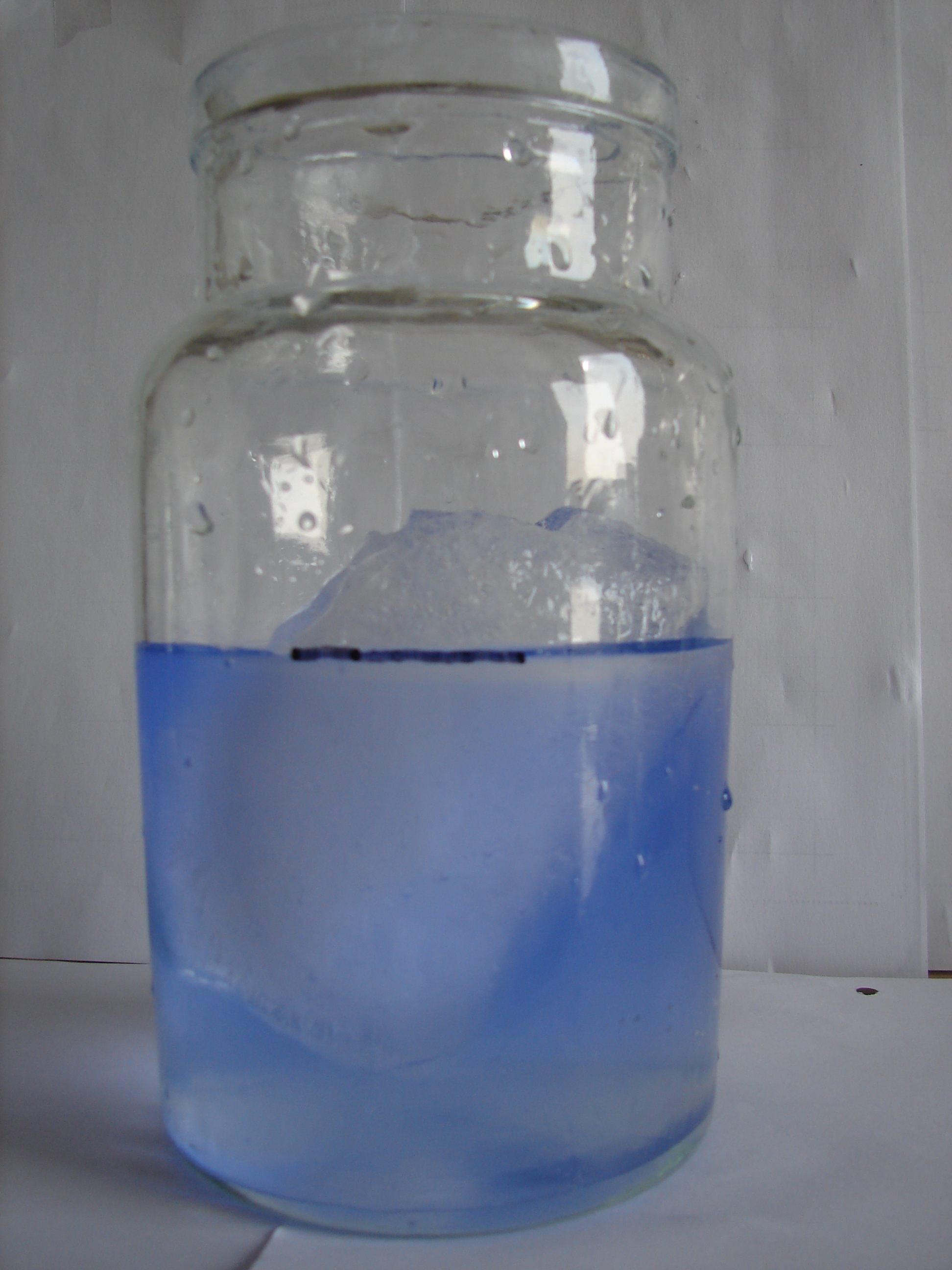
It took quite a time to melt all ice but finally it was done and the result is clear: The water level is higher!
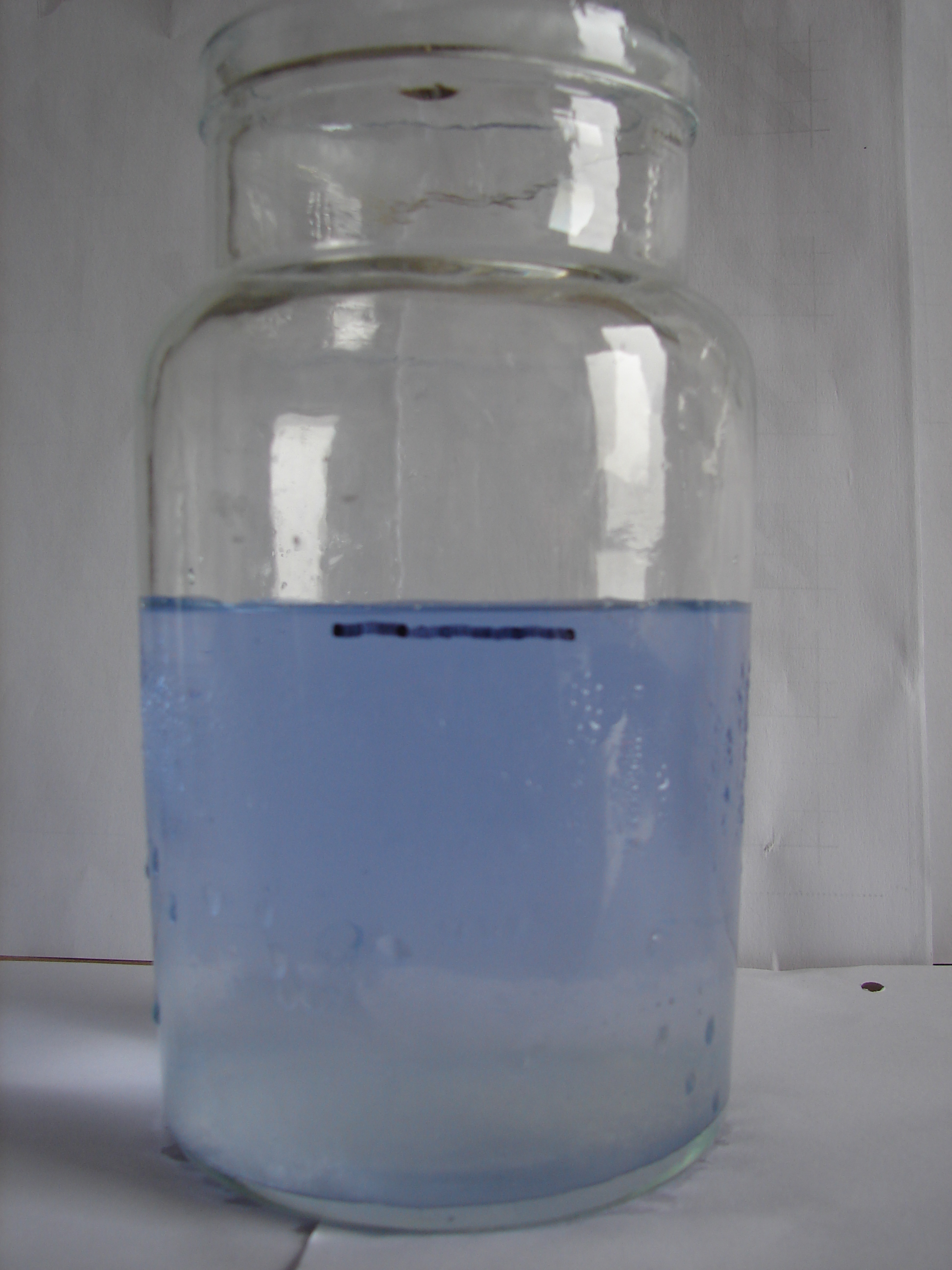
Doesn’t that contradict Archimedes’ principle?
According to Noerdlinger and Brower (2007) it doesn’t because the principle refers to weight and not volume. The salt in sea water raises its density from about 1000 kg/m3 for salt free water to 1026 kg/m3 for normal sea water. The ice however is nearly salt free because of a process called “brine rejection” (the salt from sea water doesn’t enter the crystal structure of ice).
When the ice melts then this is a kind of freshening of the ocean and the overall salinity is lowered. The lower salinity, the lower density and the larger volume.
The melting of sea ice therefore doesn’t increase the mass but it increases the volume and therefore causes the water level to rise. After Noerdlinger’s and Brower’s calculations the volume of the meltwater is about 2.6% larger than the displaced sea water.
But what is the actual relevance of this effect? Does is contribute significantly to sea level rise? Before answering this questions we should deal with an objection raised by Jenkins and Holland (2007). They are arguing that a huge amount of energy is required to melt the ice. They find that the energy comes from the ocean, as the albedo (reflectivity) of ice is very high, it doesn’t absorb much solar energy. Hence the ocean will cool a bit, causing the density of the briny water to increase (It should be noted that fresh water exhibits the peculiar behavior that its density increases as the temperature falls almost all the way to freezing; but just before freezing, the density is reduced. Briny water does not exhibit that reversal). The cooling therefore offsets the density decrease at least partially in the words of Jenkins and Holland.
As they put it, Noerdlinger’s and Bower’s result is a good first approximation in cold waters where most floating ice is found. The density of cold water is mainly determined by its salinity while for warmer water temperature is also an important factor. Therefore in warmer water the cooling effect matters.
Back to the question, if this effect contributes to sea level rise in a relevant way. Shepherd et al 2010 examine this. They combine satellite observations for an assessment of the loss of floating ice. According to this 743 km3/yr floating ice was lost in average between 1994 and 2004. They further conclude that 1.6% of current sea level rise (about 3.1 mm per year) is caused by loss of sea ice. This is not very much compared to other sources. However the authors assert that this effect should be considered for future assessments of global sea level rise.









[DB] For all the reasons you mention, I refer to the Arctic Ocean sea ice cap as the Northern Hemisphere's refrigeration system. That ice cap is being lost at record rates; once it is gone the thermostat will get ratcheted up.
As for the rates of oceanic warming sans ice...that picture is complicated by issues with turbidity, mixing layers and changing currents all now relatively constrained by the ice cap. We'll all be taking that journey together, so we'll see.
I also recommend watching this video on why CO2 is the biggest climate control knob in Earth's history.
Further general questions can usually be be answered by first using the Search function in the upper left of every Skeptical Science page to see if there is already a post on it (odds are, there is). If you still have questions, use the Search function located in the upper left of every page here at Skeptical Science and post your question on the most pertinent thread.
Remember to frame your questions in compliance with the Comments Policy and lastly, to use the Preview function below the comment box to ensure that any html tags you're using work properly.
thorconstr - read and abide the comments policy.
[PS] Thorconstr - please carefully read the comment policy. Conformance in not optional. Note especially the section on sloganeering (making assertions without supporting evidence) and the prohibition on political statements. This a site to discuss science. There are plenty of other places for political rants.
Floating ice (not a huge chunk leaning on the side of a jar) such as the polar ice cap, displaces the same amount of water as ice as it does as water, there is no change in level. Ice on land such as Antarctica and Greenland would affect sea level although given the land mass of Greenland the affect would be small and Antarctica with an average tempreature of -30 is not an issue. See the site below for a proper demonstration of melting ice and water level. See Archimedes principal as well.
http://www.youtube.com/watch?v=aOCqHRpQh88
thorconstr:
You really should read through the papers hyperlinked in the OP before writing in a comment that appears to presume the simple experiment is the end of the matter - and ignoring the point made that the melting sea ice in salt water changes the salinity and temperature of the water, therefore changing its volume.
Your claims regarding Greenland and the Antarctic appear to be purely arguments from ignorance. They are also off-topic, so if you want to pursue them further (with references) please look up appropriate threads to do so.
I pressume that a piece of ice supported by the side of a jar is not a good representation of floating ice. Antarctica and Greenland are not off topic because they represent ice that is supported as is the ice leaning on the side of the jar. This experiment is misleading. Can you comment without attacking?
thorconstr:
The impression I get is that you are not reading the OP, or my comment, very carefully, if at all.
The OP notes:
Even though the OP explicitly notes Archimedes' principle, and explicitly notes that the principle does not take into account changes in salinity and temperature in ocean water from melting ice, and explicitly provides a reference discussing the phenomenon, you ignore it all and state:
as if somehow, despite having discussed the principle, the OP is somehow ignorant of it.
You yourself specified that the Antarctic/Greenland ice was land ice:
As such your following comments were off topic. If you now wish to bring up floating ice shelves, that is indeed topical, although I do not see how bringing up floating ice shelves lends any support to your claims.
Thorconstr,
The ice leaning on the side of the jar is only supported sideways, not up and down. It has no effect on the experiment. The setup of the jar makes the experiment easy to see.
When I search "Greenland ice sheet sea level rise" the first hit is Wikipedia which states that the melting of Greenland will result in a 24 foot rise in sea level. Since I live in Florida that seems like a lot to me since over half the state (home to over 10 millionj people) would be inundated. Climate Central only goes up to 10 feet of rise so their maps are much too conservative. I do not know anyone who thinks this "affect would be small". Perhaps if you look up data before you post you will seem less uninformed. This thread is better for Greenland discussion
Antarctia is melting from below due to the increase in ocean temperatures. The fact that the average temperature is -30C does not matter when the bottom of the ice is melting due to heat in the ocean. You are spending too much time reading skeptic blogs that do not know what the facts of the matter are. This thread is good for Antarctia.
Just this morning I listened to this podcast of Chris Mooney interviewing Dr. Richard Alley. Really interesting discussion that brought out a number of points I was unaware of. One being that the gravitational mass of these major ice sheets also plays a role in sea level rise. The ice sheet are so massive that the exert gravitational pull on the ocean around them, thus as they melt, the reduced gravitational pull results in ocean's mass being more evenly distributed around the globe. Wow!
The other one was, the summits of the major ice sheets are currently fairly high in altitude. As the ice sheets melt the lower altitude of the summits will mean they are in warmer air and thus have an amplified melting effect.
Michael, Why don't you do the experiment again with a piece of ice that floats without leaning on the side of the jar? Ice on land such as Antarctica and Greenland would affect sea level just as the friction of the ice leaning on the jar showed a wrong conclusion. Put a piece of ice in the jar, fill it completely to the top with water as in the you tube video and watch the outcome.
thorconstr... Perhaps you should replicate the experiment with the modifications you're suggesting and see whether you get similar results. That would be the normal response.
thorconstr... Just remember, this experiment here is using ice in salt water, not fresh water. The video you linked to is not using salt water.
Thorconstr,
The normal business in Science is for you to do the experiment over since it is you who challenges the result. Since the result is backed by calculations and is the result I expected, it is a waste of my time to replicate a result that is exactly what I expected it to be.
Skeptics have this expectation that any crazy idea they get has to be countered by scientists doing real experiments. The onus is on the skeptics to actually do the experiment and proove that the accepted result is in error.
OK here you are. The solution is fresh water made to be salt water at 35,000 ppm of sea salt. The ice is fresh water, the pictures are at 30 minute intervals. There is no rise in the level when total melt is achieved. The paper towel is dry. Your result is exactly what you expected it to be because your ice was not in free float, it was leaning on the glass top and bottom. Try an honest experiment, I'm not impressed.
[DB] Accusations of dishonesty are a Comments Policy violation. Please familiarize yourself with the Comments Policy and comport your comments with it. Subsequent comments by you constructed thusly will be summarily deleted.
I must congratulate thorconstr @35 for going ahead and carrying out the experiment. Perhaps, however, he should look more closely at the photos. Clearly in the bottom photo, showing the glass with ice cubes, the water level is slightly below the level of the lip of the glass. In contrast, in the top photo, in which the ice has melted, the water level is slightly above the lip of the glass, being only held in by surface tension. Contrary to his presumption, therefore, his experiment has merely confirmed the result discussed in the OP, and which he disputes.
There is the same amount of the lip of the glass showing above the water in all of the photos. However, you are going to see he results your agenda demands. I know the results, they were gotten honestly, not with trickery, I don't need to waste my time here.
thorconstr @37, to avoid the risk of seeing only "the results [my] agenda demands", as you put it, I asked my teenage daughter to assess the water levels without prompting as to what she should see, or what it signifies. Oddly, she saw the same as me.
Your refusal to acknowledge the evidence of your own eyes clearly demonstrates who has the agenda here.
thorconstr@37,
I've seen the same as Tom@5. Further, honestly, I didn't even read the article (I was just lured by your beautiful pictures), so I wasn't encumbered by any thought process. That's already 2:1 against your "agenda" but I admit my observation could be inaccurate. So don't despair, together we can learn something from your beatiful pictures by calculating what science tells us and comparing with what we've seen.
So how about you tell us what was the water temperature (we already know the salinity, thanks) and the amount of ice? I assume the amount of water is ~250ml. Then I will calculate the theoretical dV/dh and we can compare it with what we've seen...
Incidentally, there is a well known trick that is often used in the classroom to demonstrate surface tension. You fill a glass to the brim with water, and then float pins on the surface, and surface tension is enough to support the pin. The pin still displaces water in accordance with Archimedes principle, but the water doesn't overflow the glass as the surface tension at the edge of the glass is surprisingly strong. All that happens is that the meniscus rises slightly. You can't get the meniscus that high by pouring the water into the glass because the drops don't drop in gently enough and the waves mean that the surface tension can be overcome.
Now thorconst says that the meniscus hasn't changed, but you can't measure it accurately by eye. Thorconsts response is a demonstration that (as usual) the skepticism of the skeptics is rather one sided, so the talk of an agenda is rather ironic.
If he/she were really a skeptic they would repeat the experiment using a flask that wasn't filled to the brim and mark the bottom of the meniscus as martinS did as this is the only way that you can measure it accurately. He/she would also use a larger ratio of ice to water to make the effect as large as possible to make it as easily measurable as possible (which he/she clearly didn't the first time, but MartinS quite sensibly did). Lastly having a better intuition for physics might help, it is hard to see how much support vertical glass can have on melting ice (both notably slippery substances).
I find it amusing that you are sceptical about my experiment where the level remains constant from picture to picture, but a huge chink of ice leaning top and bottom against the container and not freely floating does not concern you. I have better things to do than cheat to prove a point. An now I'm going to do them. Adious.
[JH] Parlor tricks are rarely well received on this website.
thorconstr, why did you move the glass mid-experiment? Also, are you going to answer chriskoz?
The glass was never moved, the camera angle was different. No.
[PS] While trying to rewrite Archimedes principles with poorly controlled experiments might be entertaining, I would ask all concerned to note from the original article.
"They further conclude that 1.6% of current sea level rise (about 3.1 mm per year) is caused by loss of sea ice." (emphasis mine)
and wonder if there are more important parts of the science to discuss?
"the camera angle was different."
The camera angle sucks. Why did you take the pictures at an angle that makes it so hard to see the level? The last picture is obviously much closer to horizontal than any of the others. Even with the poor camera angle, put me in the group that says the water level looks higher in the last picture.
[PS]@43,
That's exactly what I was hoping to show @39 if thorconstr had given me the parameters needed to calculate the expected outcome. Depending of the results of the calculations, say if dh more than 0.5mm, then we would be able to confirm or bust this science. Otherwise (more likely IMO) we would conclude the experiment requires refining because it was impossible to tell. So the experiment would be useful & we would end up wiser.
Sadly, Thor chose to decline my friendly and open minded invitation, instead accusing people of some imaginary "agenda" when they saw something he didn't like. Why so? This piece is AGW-neutral, therefore there should be no "controversy" here... All I can say is: that's typical behaviour of a science denier in general.
As unimportant this piece in the big picture of climate science is, it shows the classic example of science denial represented by Thor here. I was hoping that Thor's experiment shows inquisitiveness of mind (I agree with the appraisal by Tom@36) but in the end, Thor disappointed me big time showing the attitude that has nothing to do with typical constructive skepticism, as his user name would suggest...
thorconstr wrote "I find it amusing that you are sceptical about my experiment where the level remains constant from picture to picture",
The amusing thing is thorconstr utter lack of self-skepticism about his own experiment, which is sad because self-skepticim lies at the heart of science.
The level does not remain constant from picture to picture. In the picture with the ice the meniscus is clearly concave around the rim of the glass, in the picture without the ice it looks to be convex around the rim. The lack of a constant camera angle (poor scientific practice) makes it difficult to be absolutely sure of this. Thorconst should reat his experiment properly, and use a glass with vertical sides, not fill it to the brim and mark the bottom of the meniscus as MartinS did as that is the only sensible way of performing the experiment. Also thorconstr should use a larger ratio of ice to water to make any change in volume as large and easy to measure as possible (as MartinS sensibly did). Of course thorconstr wont actually do this, because there is a limit to most skeptics sckepticism - it doesn't extent to themselves.
"but a huge chink of ice leaning top and bottom against the container and not freely floating does not concern you."
I've asked this before thorconstr, but exactly how can a vertical glass wall support a block of melting ice, both substances notable for their slipperyness?
Despite the triviality of the topic, I'll have one more go.
Suppose you have two large tubs of water at 0 degrees C, one containing a cubic meter of fresh water, and the second containing a cubic meter of sea water (salt content = 35 g per liter). The density of the water in the first case is 999.868 Kg/m^3. In the second it is 1028.131 Kg/m^3. In both tubs you place half a cubic meter of ice, also at 0 degrees C.
The first question I have for those doubting the science (such at thorconstr), is in which tub does the ice ride highest? That is, in which tub is the greatest volume of ice above the level of the water?
As it happens, the density of ice at 0 degrees C is 916.2 Kg/m^3. Hence 0.5 cubic meters of ice has a mass of 458.1 Kg. By Archimedes Principle, we know that the weight of the displaced water equals the weight of the floating object. Thus the block of ice will displace 458.1 Kg of sea water, and the same mass of fresh water. Because of their different densities, however, that means it will displace 0.458 m^3 of fresh water, but only 0.446 m^3 of sea water. That is, the ice in fresh water ill have only 0.042 m^3 above the surface, but 0.044 m^3 above the surface if floating in fresh water. It floats higher in sea water.
We can carry that one step further. If the ice melts it will occupy a volume of 0.458 m^3. That is, it will occupy the same volume as was displaced by it in fresh water, but 0.002 m^2 more volume than it displaced in sea water. That excess volume must result in a rise in the water level. To deny that fact requires us to insist that the displacement of a body is the same regardless of the density of the fluid in which it floats.
The science involved in this case is not that difficult. It is as simple as realizing that ice will float higher in a denser fluid. It is even simple enough to be taught in high school chemistry (in the UK). The problem is that having got a fixed and inaccurate view of that Archimede's Principle states, thorconstr's mind is not open to subtleties that follow from the actual principle.
"I've asked this before thorconstr, but exactly how can a vertical glass wall support a block of melting ice, both substances notable for their slipperyness?"
I can't believe you ask this, no matter what the surface, when things rub they cause friction which would affect the experiment. My background is as a high voltage lineman 15 years, high end home builder 18 years, private pilot, and building high end cars for fun. I don't profess to be a scientist, I do have a lot of "real world" knowledge. Everyone here accepted the first experiment without question, the experiment is far from professional yet you accept it like the "Holy Grail", not a negative response, and you all have problems with mine. Mine wasn't intended as a professional experiment. If I found that I was wrong I would have said so. If I blow the pictures up to show only the glass rim the water level is the same, whether you believe it or not. In retrospect, posting on a such a totally left leaning sight was a mistake. And I unlike most on this site do have an "open mind".<Snip>
[PS] Commentators have pointed out problems with your experiment and reasonable improvements, as well as detailed explanations of the principle at work here (Tom). Responding to these comments would be better than throwing insults. Your conjecture that no rise in water level is what is expected overthrows a few thousand years of knowledge so the onus lies with you.
thorconstr @48, what I (and I suspect nearly everyone) accepted was not the "first experiment", but the analysis based on a detailed knowledge of the relevant scientific principles and values by two experts in the field as detailed in the paper found by following the first link in the article. Some of us may also have done analyses similar to mine @47 to test that the result genuinely followed from known scientific principles (or used an alternate method based on calculating the new salt concentration after melting of the ice, and determining the difference in density that results). I (and I suspect nearly everyone) considered the illustrations to be merely a usefull illustration, not explained in sufficient detail for anything but illustrative purposes.
Your "experiment", in contrast, lacks relevant details, is poorly constructed and gives results constrary to what you claim. It is certainly an inadequate basis for over turning a basic scientific principle (which is what you are attempting to do, though you do not recognize the fact).
<snip> I am only interested in one response from you. Does ice floating in sea water float higher, lower, or the same as ice floating in fresh water?
[PS] A reasoned debate is more likely without implied derogatory observations. This applies to everyone.
thorconstr wrote "I can't believe you ask this, no matter what the surface, when things rub they cause friction which would affect the experiment."
O.K. so the question is how much friction would there be, and would it be enough to materially affect the outcome of the experiment. I would say that the friction involved would be negligible as ice and glass, both lubricated by a film of water, are both extremely slippery materials. Note that as the ice is melting there won't be much of a connection between the solid surfaces as the surface of the ice will be constantly melting. Note the reason that ice skating is possible is that a thin film of water removes what little friction there was between the ice and the blade of the skate.
"Everyone here accepted the first experiment without question, the experiment is far from professional yet you accept it like the "Holy Grail", "
This is hyperbole. It is a simple experiment that verifies something we already know from very basic theory (as Tom pointed out to you). If you get the science right, you don't need this sort of rhetoric.
"Mine wasn't intended as a professional experiment."
neither was MartinS's, I suspect, and yet you chose to question the honesty of his experiment, when it was actually performed rather more professionally than yours - at least the meniscus could be measured properly in his.
" If I found that I was wrong I would have said so. "
We try running the experiment again, using the suggestions I gave.
"If I blow the pictures up to show only the glass rim the water level is the same, whether you believe it or not."
How many times do I have to say that you can't accurately measure the meniscus this way by eye. Blowing up the pictures doesn't change this fact.
"In retrospect, posting on a such a totally left leaning sight was a mistake."
Physics is independent of political orientation. Try doing the experiment properly.