



 Arguments







Newcomers, Start Here
Posted on 15 August 2010 by John Cook
Skeptical Science is based on the notion that science by its very nature is skeptical. Genuine skepticism means you don't take someone's word for it but investigate for yourself. You look at all the facts before coming to a conclusion. In the case of climate science, our understanding of climate comes from considering the full body of evidence.
In contrast, climate skepticism looks at small pieces of the puzzle while neglecting the full picture. Climate skeptics vigorously attack any evidence for man-made global warming yet uncritically embrace any argument, op-ed, blog or study that refutes global warming. If you began with a position of climate skepticism then cherrypick the data that supports your view while fighting tooth and nail against any evidence that contradicts that position, I'm sorry but that's not genuine scientific skepticism.
So the approach of Skeptical Science is as follows. It looks at the many climate skeptic arguments, exposes how they focus on small pieces of the puzzle and then puts them in their proper context by presenting the full picture. The skeptic arguments are listed by popularity (eg - how often each argument appears in online articles). For the more organised mind, they're also sorted into taxonomic categories.
Good starting points for newbies
If you're new to the climate debate (or are of the mind that there's no evidence for man-made global warming), a good starting point is Warming Indicators which lays out the evidence that warming is happening and the follow-up article, 10 Human Fingerprints on Climate Change which lays out the evidence that humans are the cause. More detail is available in empirical evidence that humans are causing global warming. Contrary to what you may have heard, the case for man-made global warming doesn't hang on models or theory - it's built on direct measurements of many different parts of the climate, all pointing to a single, coherent answer.
Another good starting point is the SkS climate graphics page, with each graphic featuring links to informative SkS material. Good introductions to climate science can be found at Global Warming in a Nutshell and The History of Climate Science. You could lose yourself for hours in those pages!
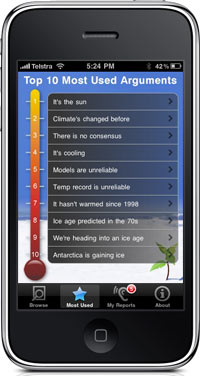 Smart Phone Apps
For smart phone users, the rebuttals to all the skeptic arguments are also available on a number of mobile platforms. The first Skeptical Science app was an iPhone app, released in February 2010. This is updated regularly with the latest content from the website and very accessible in a beautifully designed interface by Shine Technologies. Shine Tech then went on to create a similar Android app which has some extra features missing from the iPhone version. A Nokia app was also created by Jean-François Barsoum (this was one of the 10 finalists in the Calling All Innovators competition).
As well as the list of rebuttals, Skeptical Science also has a blog where the latest research and developments are examined and discussed. Comments are welcome and the level of discussion is of a fairly high quality thanks to a fairly strict Comments Policy. You need to register a user account to post comments. One thing many regulars are not aware of is you can edit your user account details (to get to this page, click on your username in the left margin).
Keep up to date by email, RSS, Facebook or Twitter
To keep up to date on latest additions to the website, sign up to receive new blog posts by email. There's an RSS feed for blog posts and for the engaged commenter, a feed for new user comments. I recommend you follow the Skeptical Science Twitter page as I not only tweet latest blog posts but also any other interesting climate links I happen upon throughout the day. New blog posts are also added to our Facebook page.
About John Cook
Lastly, for those wondering about who runs Skeptical Science, the website is maintained by John Cook. I studied physics at the University of Queensland but currently, I'm not a professional scientist - I run this website as a layman. People sometimes wonder why I spend so much time on this site and which group backs me. No group funds me. I receive no funding other than the occasional Paypal donations. As the lack of funding limits how much time I can spend developing the site, donations are appreciated.
My motivations are two-fold: as a parent, I care about the world my daughter will grow up in and as a Christian, I feel a strong obligation to the poor and vulnerable who are hardest hit by climate change. Of course these are very personal reasons - I'm sure everyone comes at this from different angles. I go more deeply into my motivations in Why I care about climate change.
The SkS Team
However, there are many more who make invaluable contributions to Skeptical Science. There are a number of authors who write blog posts and are currently in the process of writing all the rebuttals in plain English. Translators from all over the world have translated the rebuttals into 15 different languages. There have been contributors to the one-line responses to skeptic arguments, proofreaders, technical support from boffins who understand computers a lot better than myself and commenters whose feedback have helped improve and hone the website's content. Skeptical Science has evolved from a small blog into a community of intelligent, engaged people with a commitment to science and our climate.









[DB] Curious, that an "old fashioned" scientist up-to-speed enough on technology to be able to post on this forum was not then able to take the next step and search via Google for the requested data?
Conveniently, links to all said "raw data" are available (as others have noted) here:
The collector's casual/informal notes are an unnecessary complicating factor (adding bias/noise) for old-fashioned scientists seeking to replicate the work of others. Unless your intent was merely to "audit" the work already done...?
I have a question. I read somewhere about a possible Venus effect with Earth's global warming. The writer posited that Venus' Runaway global warming hypothosis created Venus's atmosphere as it is today and could be a possibility for Earth if it succumbs to runaway global warming. The writer went on to say that the artic melt would allow large quantities of methane to be released into the atmosphere as well as acidification and warming of oceans would cause phytoplankton to die off and thereby the absorption of CO2 by the phytoplankton would cease or be greatly reduced and these along with other factors would cause Earth's atmosphere to become like Venus'. Is this scenario plausable?
gaiafollower @234, a Venus like runaway greenhouse effect is not currently possible on Earth based on the best evidence to date. That is, the Earth's oceans will not boil away, and cannot be made to boil away simply by adding CO2 (and/or methane) to the atmosphere; although in several billion years they will boil away due to the Sun getting hotter with time.
On the other hand, it is perfectly possible that feedbacks from anthropogenic CO2 could result in feedbacks resulting in an increase in temperature of 10 plus degrees C, a situation that will make parts of the Earth literally uninhabitable due to heat. Those scenarios are not plausible, however, in the short term. Only when temperatures start reaching 4-5 C above current levels will further increases plausibly push us into that sort of feedback regime.
Hey gang, great site. I've recently discovered an old aquaintance of mine, to my surprise, is a rabid climate "skeptic.". He's used arguments that seem pretty obviously bogus, but I don't always have my ducks in a row to counter them. For myself, the eye opener for me was the Jerry Mitrovica video on sea level. But that was not convincing to the skeptic who thinks it was biased by funding. That's a good catch-all for anything you disagree with. He's also claimed that to insist on peer-review is cherry picking, "there's a lot of articles out there that disagree, the idea that in the last year only 1 was published that was contrarian is false". His aruments seem to hinge on that catch-all, funding bias.
One claim of his is that the reason there is apparent consensus is that all of the scientists accept grant money that influences them to find in favor of AGW. This seems to me to be rather a vague claim, as a quick look reveals grants coming from many institutions, such as the NSF, NASA, Naval Research, NOAA, many Universities, etc. I think the "skeptic" respose would be all of these are biased. I know a few working scientists, and grant money seems often hard to come by, but none of the scientists I know are climatologists. I also don't see this argument addressed directly as one of the numbered favorites-- any idea where I could find out more? Better info on the grant processes in general? My gut tells me the claim doesn't hold water, but I don't really have any relevant details...
ZincKidd, your friend has a basic misunderstanding about climate science. This is probably due to not having read any of it. Have him show you work that undermines the basic physics involved.
Still, it's one of the silliest arguments there is. The basic claim is that scientists are fudging studies in order to toe the line. In other words, climate science is a hoax. Since the basic theory is well over 100 years old, that means that at least five generations of scientists working in climate-related areas are part of the hoax. It also means that decades' worth of graduate students in atmospheric science and physics are also part of the hoax. And all the editors of all the journals. All of these people have been publishing fictions. That takes talent. Think about it. A working scientist must get together with his team and design a study that undetectably perpetuates the fiction. Since climate science is progressive and interdisciplinary, it's like a giant house of cards. Every study published is a potential weak link in the house.
Yet no one has been able to locate the hoax. Upwards of a million people involved (all living and dying with the secret), and no one has ever figured out the fictional element of physics upon which the entire house is based.
Heck, even the Earth is involved in the hoax. Arctic sea ice volume at summer minimum is at roughly 20-25% of its 1979 minimum. Have your friend do the math to figure out how many joules it has taken to manage that. I guess all of the polar scientists and engineers (and Inuit!) could be in on the hoax as well.
That's what your friend wants you to believe. That's what he thinks is reality. Weigh the probability of that reality against the probability that, in fact, the science is actually describing physical reality. Show me where the lie is. That's what I'd ask. It's one thing to claim that scientists are motivated to lie for money; it's another thing to actually show evidence of a lie. Invite your friend to SkS to present his case. If there's solid evidence, I'll change my mind.
I've often found that that type of "skepticism" comes from people who haven't actually sat down and read a published paper or talked one-on-one with a scientist. They're more than happy to make broad claims about "libtard scientists" as long as they're never forced to humanize those scientists by looking them in the eye.
ZincKidd, I've wished for a more effective counter to the "funding bias" arguments of the deniers myself. Pithy retorts along the lines of "If scientists were in it for the gold, they'd be working for the fossil fuel corporations" only carry so much weight. Try this SkS discussion from a while back for some ideas.
A response from a scientist who depends on grant money is Scott Mandia's "Taking the Money for Grant(ed)".
More recently, there have been some damning studies of where deniers get their funding. It might help convince your "friend" that the accusations of funding bias are coming from people who are paid to make them.
You should keep in mind that it takes money to make money. The people who stand to lose the most if fossil fuel use is curtailed are willing to pay top dollar for skillful propaganda, to convince the public that AGW is all a hoax. Scientists, however, are ethically (and financially) constrained from adopting that strategy. It's kind of a lop-sided struggle.
The accusation probably tells you more about the mind-set of the accuser than climate scientists. Presumably they would happily do biased research for the money.
There are several erroneous assumptions involved. 1/ some think that grant money goes to the scientist - a gravy train for them - whereas reality is that funding usually goes to employer and they draw their salary. 2/ The commonest assumption is the belief than funding is tied to AGW. A look at, say, NSF grants would show funding goes to find out things that arent already known and funder doesnt care which way the results fall. 3/ It is also often thought that if AGW was shown to be false/irrelevant, then all these people would lose jobs. In practise, scientists move the next interesting problem.
You might ask, if climate science is biased, why FF companies spend money on misinformation rather than using their considerable research infrastructure to show alternative results. Answer would be that their own scientists would tell them its more effective to use PR because on the whole they find the science of AGW convincing. (I work in petroleum research).
Zinckidd @236.
Coming to this a bit late, sorry - hope you're still reading ...
One point that follows on from DSL's is why, if your friend is right, is there no Climate Change equivalent of Edward Snowden ? Now whatever you think of him, you cannot deny that the CIA and NSA managed to employ someone who, through the courage of their convictions, eventually blew the whistle on what he saw as a wrongdoing (at considerable personal cost). How come, given the size that the "Climate Change grant funding conspiracy" would have to be (and the number of years it would have to have been in action) why has no-one blown the whistle ?
Another point concerns the "ClimateGate" emails. Deniers trawled those email for evidence of wrongdoing and found only a few instances of anything of interest, all of which, under closer examination turned out to nothing more than unfortunate turns of phrase that sounded damming only when taken out of context. But there was nothing at all in the entire archive to suggest a link (either real or imagined by the researchers themselves) between funding and the results they obtained.
My go-to resource. Thanks guys. Y'all rock.
I am new to climate change and find the Comments educational. I was struck by the graph of increase of heat stored on the earth and believe it is key to climate change. However, a quick calculation will show this graph must be in error. NOAA states the ocean's volume is 1.355 E9 cubic Kilometers. This is 1.355 E15 cubic meters and a mass of 1.355 E18 Kg. If you add 20 E22 joules to that mass of water is raises the temperature of the water 35.3 degrees C. (20 E22J=4168x1.335 E18 x change in T assuming a specific heat of 4168 joule/kg/degrees C). Errors in Specific Heat and Density tend to increase this number.
Radapo,
Welcome to Skeptical Science. The more you read the more you will find interesting. SkS is a good source because many people check the calculations.
My computer says 1 km3 is 1 billion m3 so the volume is 1.335 E18 m3 and the temperature rise is only .0353 degrees. This seems like a reasonable amount to me. Obviously some parts warm more than others.
Hey there, great website, thanks for all the great information.
A friend of mine is concerned about the earths magnetic fields and how they are affecting the climate. He sent me this, can someone comfortable with the climate science comment on this and if it something that has been studied or overlooked? Thanks.
http://phys.org/news/2014-05-earth-magnetic-field-important-climate.html
[PS] Fixed link. The link only talks about changes in the "climate" of the upper atmosphere which, while important for many applications, isnt exactly what most people would think of in terms of climate change.
There is no correlation between CO2 emissions and global warming. The two are not linked closely together as inferred by Mann's hockey stick graph. Co2 is driven into and out of the environment by global temperature rises and falls.
[JH] You are skating on the thin ice of sloganeering which is prohibited by the SkS Commets Policy. In addition, you have provided no references to substantiate your assertions. Future posts of this nature will be summarily deleted.
cagwskeptic @245, was the medieval warm period as warm as, or warmer than temperature post 1998?
[PS] This is an inappropriate thread for such a discussion. Till the poster can demonstrate something other than unsubstantiated sloganeering, then please do not engage.
On this page, under "Good starting points for newbies", the first sentence includes "... a good starting point is Warming Indicators which lays out the evidence that warming is happening ..." However, the link from "Warming Indicators" is to http://www.skepticalscience.com/graphics.php?g=8 which has a graphic but does _not_ lay out the evidence.
Was that link supposed to go to a different page where evidence is actually laid out?
Might moderators find the following response to cagwskeptic helpful? If not, feel free to delete this post.
- - - -
cagwskeptic @245, Are you overlooking that:
(1) since the Industrial Revolution, manmade machines burning fossil fuels have been emitting more and more CO2 into the atmosphere,
(2) these anthropogenic CO2 emissions are in addition to all the natural processes that governed atmospheric CO2 levels before the Industrial Revolution, and
(3) recently our anthropogenic CO2 emissions have reached a magnitude that is several dozen times the amount of CO2 that volcanoes emit annually?
Hi,
Been a while since I posted here. I recall there used to be a way to make a table or graph and post it so there was a URL associated with the table or graph. Of course I would be willing to pay to have this done.
Ant suggestions?
[DB] You will need to use an image hosting service or on a website that allows the formation of a dedicated URL.
[PS] Plenty of free image hosting services out there (eg tinypic) Just dont forget to limit image width to 500. More detail at bottom of the comments policy.